

Updated on January 28, 2026
What is Electrical Frequency? The Definitive 2026 Guide
Think about the refresh rate on your monitor. A 120Hz display refreshes the image 120 times every second. In the world of electricity, the concept is strikingly similar. So, what is frequency (Hz)? Simply put, the frequency of an alternating current (AC) is the number of times an electrical wave completes a full cycle in one second. It’s the speed at which the current flips direction, switching from positive to negative and back again.
The official SI unit for frequency is the hertz (Hz), named after German physicist Heinrich Hertz. One hertz (1 Hz) equals one cycle per second. Grasping this concept is fundamental to understanding not just your home’s power grid, but nearly all the technology that powers our lives.
Frequency and Period: The Unbreakable Bond
To really master frequency, you need to know its related terms. As a pro, these are the pillars I use daily:
- Hertz (Hz): The unit of measurement, equal to one complete cycle per second.
- Cycle: One complete sine wave of voltage or current, from its starting point, up to its positive peak, down to its negative peak, and back to the start.
- Alternation: This refers to half of a cycle (either the positive or the negative portion).
- Period (T): The time, measured in seconds, it takes to complete one full cycle. It’s the inverse concept of frequency.
The relationship between frequency and period is the cornerstone of AC power, defined by a beautifully simple formula:
f = 1 / T
Where:
- f is the frequency in hertz (Hz).
- T is the period in seconds (s).
Real-world example: The power grid in Europe runs at a frequency of 50 Hz. How long does one cycle take? Using the formula, we solve for the period (T):
T = 1 / f => T = 1 / 50 Hz => T = 0.02 seconds.
This means the current in a European outlet changes direction and completes a full cycle every 0.02 seconds, or 20 milliseconds. That’s 50 times every single second!

The Great Divide: 50 Hz vs. 60 Hz Explained
One of the most common questions I get is why the world is split between two main power grid frequency standards: 50 Hz (Europe, Asia, Africa) and 60 Hz (North America, parts of South America, Japan). The reason is a historical hangover from the ‘war of the currents’ in the late 19th century. The German company AEG standardized on 50 Hz, while the American Westinghouse opted for 60 Hz. Both technologies expanded across their spheres of influence, and the standards stuck.
In 2026, these differences are still critical, especially when importing electronics or traveling. Here’s a breakdown of the technical implications of each standard:
| Characteristic | 50 Hz | 60 Hz (U.S. Standard) |
|---|---|---|
| Common Regions | Most of Europe, Asia, Africa, Australia. | USA, Canada, Mexico, Brazil, parts of Japan. |
| Motor Speed | Induction motors spin 20% slower than on 60 Hz grids. | Motors spin faster, which can be an advantage in certain applications. |
| Transformer Losses | Slightly higher due to iron core losses. | More efficient, allowing for slightly smaller transformers for the same power rating. |
| Power Transmission | Lower reactance losses over long distances. | Higher losses on very long transmission lines. |
| Lighting Flicker | More perceptible in older lighting (fluorescent, incandescent). By 2026, with LED lighting, this is nearly irrelevant. | Less perceptible, as the light refreshes 20 more times per second. |

How to Measure Frequency the Right Way
For any tech pro or serious DIYer, measuring frequency is a common diagnostic task. The go-to tool for this job is a digital multimeter with a frequency counter function. By 2026, nearly all models, even entry-level ones, include this feature.
If you need to know how to measure frequency, follow these steps with extreme caution:
- Safety First: Always wear electrician’s gloves and safety glasses.
- Set Up Your Multimeter: Turn the rotary dial to the Hertz (Hz) function. If it shares a setting with Voltage (V~), make sure you’ve selected Hz.
- Insert the Probes: Connect the black probe to the COM jack and the red probe to the V/Hz jack.
- Measure Carefully: Insert the probe tips into the terminals of the outlet or the point you want to measure, just as you would for a voltage reading.
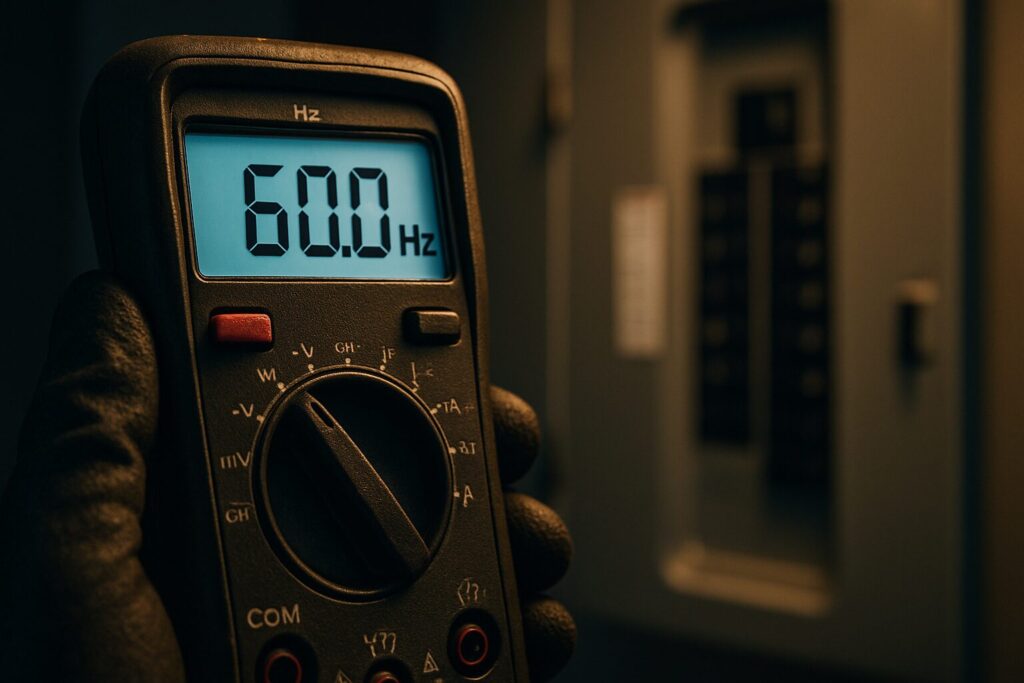
- Read the Display: The screen will show the signal’s frequency. In the U.S., it should read a value very close to 60.0 Hz.
For an accurate measurement, especially on non-sinusoidal signals, you need a multimeter that measures True RMS (Root Mean Square). In my experience, investing in a quality tool is essential for getting reliable and safe readings.
Frequency in Action: 2026 Tech Applications
Frequency isn’t just about the power grid; it’s a key parameter in almost every field of modern technology:
- Power Grid: 50 Hz or 60 Hz, the foundation of our daily lives.
- Power Electronics: Variable Frequency Drives (VFDs) that control industrial motors operate with carrier frequencies from 1 to 20 kilohertz (kHz).
- Audio Range: The human ear perceives frequencies between 20 Hz and 20 kHz.
- Wireless Communications: This is where frequencies skyrocket. The Wi-Fi 7 standard, well-established in 2026, operates on the 2.4 Gigahertz (GHz), 5 GHz, and 6 GHz bands. And the emerging 6G mobile networks are already exploring the Terahertz (THz) range for mind-blowing speeds. This requires advanced network management, even at home.
Frequently Asked Questions (FAQ) About Electrical Frequency
- 1. What happens if I plug a 60 Hz appliance into a 50 Hz outlet?
- It depends on the device. An AC motor will run about 20% slower and may overheat. Modern electronics with switched-mode power supplies (like a laptop charger) are usually dual-compatible (check the label for “50/60Hz”). An older device with a clock timed by the grid frequency, like some vintage alarm clocks, will run slow.
- 2. Does frequency affect my electricity bill?
- Indirectly, yes. Frequency impacts the efficiency of components like motors and transformers. A motor designed for 60 Hz running on a 50 Hz supply might be less efficient, thus drawing more power to do the same amount of work and risking damage. For precise control of your energy costs, using a good energy monitor is always my top recommendation.
- 3. Why does the power grid frequency have to be so stable?
- Frequency stability (e.g., 60 Hz ±0.1%) is a key indicator of the entire power grid’s health. If energy demand exceeds generation, the frequency drops. If generation outpaces demand, it rises. Grid operators work 24/7 to maintain this perfect balance, ensuring everything from industrial machinery to your oven’s clock runs correctly.
- 4. Does every country use either 50 or 60 Hz?
- The vast majority do. There are a few niche exceptions, like railway traction networks in some European countries that use 16.7 Hz, but for general public power supply, 50 and 60 Hz are the universal standards.
Follow Me on YouTube