
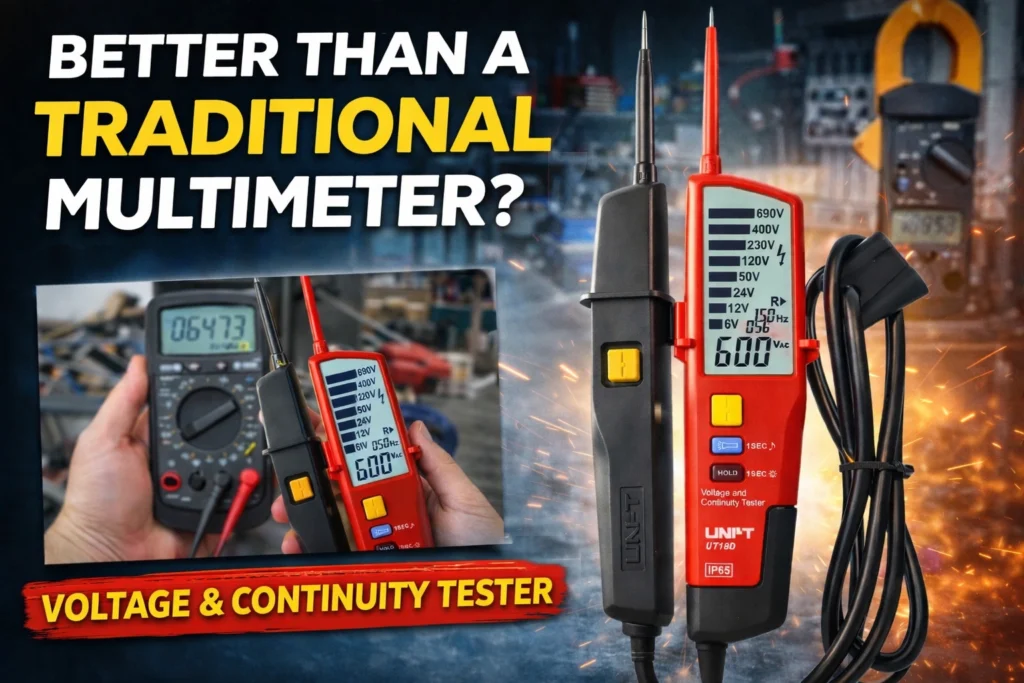

Think of the UT18D as a step beyond the traditional multimeter. It is a two-pole voltage and continuity tester designed to be a fast and safe diagnostic tool. Its main function is to verify the presence of voltage (AC and DC), check circuit continuity, detect polarity, and, very importantly, test Residual Current Devices (RCDs).
This tool is intended for both the professional electrician who needs a reliable workhorse and the advanced hobbyist who takes safety seriously. Its robust design makes it suitable for demanding environments like construction sites or workshops, where dust and moisture are common.
Key Features of the UNI-T UT18D
Let’s break down what this device offers, without unnecessary technical jargon.
AC/DC Voltage Measurement and Auto-Ranging
One of its most appreciated features is its simplicity. The UT18D automatically detects the voltage range (from 12V to 690V), so you don’t have to select it yourself. It displays the measurement on both its LCD screen and with LED indicators, allowing for a quick reading. It measures both alternating and direct current, covering most needs.
Continuity Test and RCD Test
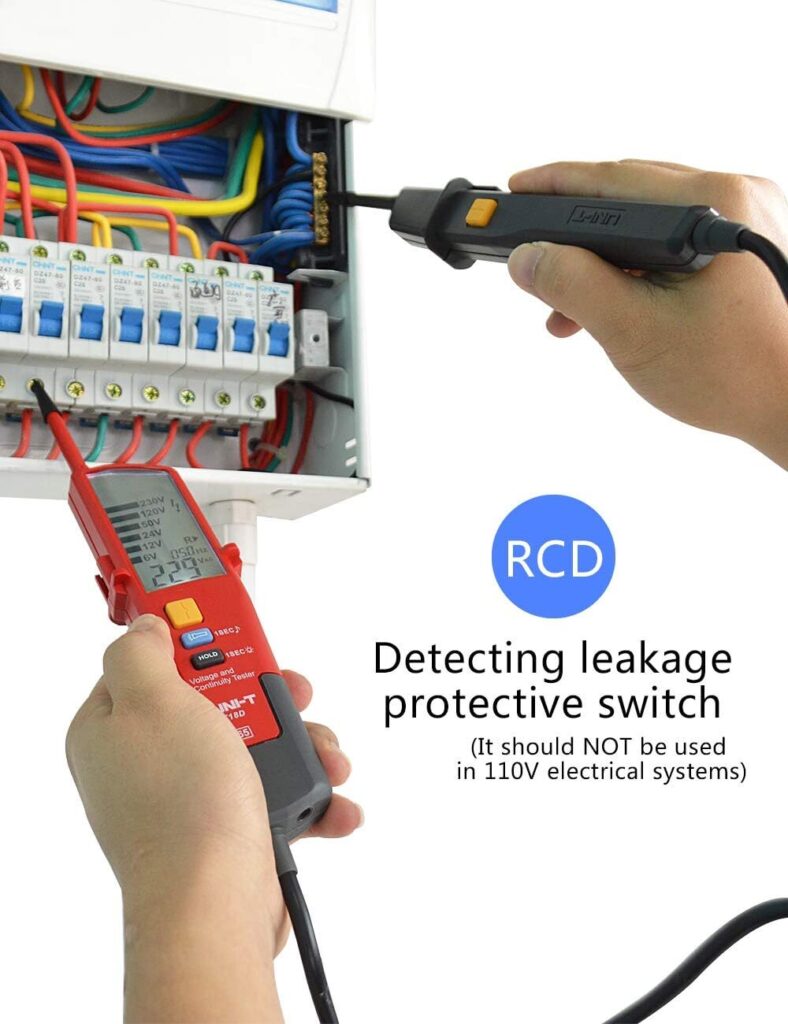
This is where it starts to stand out. The continuity test is basic, with a beep to let you know if the circuit is closed, but it works consistently. The star of the show is the RCD test. With the push of a button, you can trip the installation’s RCD to verify it’s working correctly. This is a crucial safety feature you don’t often find in devices at this price point.
Robust Design with IP65 Protection
If you’ve owned tools that couldn’t handle rough use, you’ll value this. The UT18D feels solid in the hand and has an IP65 certification. This means it is completely protected against dust ingress and can withstand low-pressure water jets. It’s not submersible, but it will easily endure a workday in the rain or a dusty environment.
LCD Screen and Additional Features
The backlit LCD screen is clear and easy to read in low-light conditions. It also includes a small LED flashlight to illuminate the work area—a practical detail that always comes in handy. It also features polarity detection for DC current and an auto-standby mode to help conserve batteries, although some users note that consumption can be high.
Detailed Technical Specifications
For an at-a-glance overview of all the data, here is a clear and direct technical sheet.
| UNI-T UT18D Technical Sheet | |
|---|---|
| Measurement Type | Voltage and Continuity Tester |
| Voltage Range | 12V, 24V, 50V, 120V, 230V, 400V, 690V (AC/DC) |
| Key Functions | Continuity Test (with buzzer), RCD Test, Polarity Detection, Frequency Measurement (40Hz-400Hz), Phase Sequence Test. |
| Protection | IP65 (Resistant to dust and water jets) |
| Display | LCD (73.5 x 35.5 mm) with backlight |
| Extras | Integrated LED flashlight, Low battery indicator, Auto-standby mode. |
| Power Supply | 2x 1.5V LR03 (AAA) Batteries |
| Phase/Neutral Detection | Weak Point: Unreliable with a single pole, according to professional reviews. |
Pros and Cons According to User Reviews
This is where we get serious. Specifications are one thing, but real-world use is another. Here’s what daily users are saying.
Strengths: Robustness and Value
Almost everyone agrees: this is a robust and durable tool. Several electricians coming from older UNI-T models state that the build quality has significantly improved. It is perceived as a reliable device that won’t let you down.
For its price, the inclusion of the RCD test and IP65 protection makes it a very compelling option. It performs its main functions consistently and accurately, making it a smart purchase if its features align with your needs.
Weaknesses to Consider Before Buying
Now, let’s be completely honest about its weak points, which are important.
The Big Problem: It doesn’t reliably distinguish between Phase and Neutral. This is the most frequently reported flaw by professional users. For an electrician, knowing which of the two wires is the phase (hot) is an essential daily task. This device does not perform this detection clearly with a single probe, which for many is an unforgivable defect and a reason to return it. If this function is critical for you, this is not your tester.
The manual is often not in English. A classic issue with imported products. The manual may come in other languages, and while the device is intuitive, you’ll miss the details to get 100% out of it. You may need to rely on translators or tutorials.
It lacks Non-Contact Voltage (NCV) Detection. Don’t expect to detect if a wire is live just by bringing the device close. The UT18D works by direct contact. This isn’t a flaw but a design characteristic you should be aware of before buying.
No case included. A minor detail, but we all like to protect our tools. You’ll have to find one on your own.
Conclusion: Is the UNI-T UT18D Worth Buying?
The million-dollar question. My answer is: yes, but only if you know what it’s for.
For a professional electrician, I would see it as an excellent secondary or specialized tool. It’s perfect for taking to a construction site due to its robustness, for verifying the proper functioning of RCDs, or for quick voltage checks. However, because of its inability to distinguish the phase wire, I would not choose it as my primary, go-to tester.
For the advanced DIYer or handyman, it’s a highly recommended option. It offers a level of safety and reliability superior to basic multimeters. If you don’t need to constantly identify phase wires, its features, solid construction, and price make it a very capable tool that will last for years.
Frequently Asked Questions (FAQ)
Can the UNI-T UT18D multimeter differentiate between the phase (hot) and neutral wire?
According to professional user reviews, the UNI-T UT18D does not reliably differentiate between phase and neutral when using a single test probe. This is its most criticized limitation and a deal-breaker for many electricians.
Does this device include a non-contact voltage (NCV) detection feature?
No, the UNI-T UT18D is a tester that requires direct contact with conductors to measure voltage. It does not incorporate the NCV function, which allows for the detection of electric fields at a distance.
Does the UNI-T UT18D instruction manual come in English?
Not always. Product information and buyer reviews confirm that the manual is often supplied in other languages. This can be an inconvenience for users who want to understand all its features in detail.