
This article may contain affiliate links. If you buy through these links, the price is the same for you and the store pays me a small commission that helps keep Tecnoyfoto running.

Last updated on February 23, 2026
In the breakneck world of the smart home, where standards evolve and new gadgets drop every month, it’s fair to ask: does a “classic” Zigbee sensor still have a place? This Sonoff SNZB-02DAffiliate link Review for 2026 tackles that question head-on, taking a deep dive into a device that, despite its age, remains one of the most reliable and budget-friendly ways to monitor temperature and humidity in Home Assistant.
Is the Sonoff SNZB-02D Still Worth It in 2026?
The short answer? A resounding yes—but with a few caveats. Here in 2026, with the Thread protocol and Matter gaining serious traction, a Zigbee-only device like this might seem like a dinosaur. However, its greatest strength lies in its maturity and simplicity. Zigbee is a rock-solid standard with a massive ecosystem of devices and, most importantly, it operates 100% locally, with zero cloud dependency.
For any serious Home Assistant user, local control, privacy, and reliability are the holy trinity. The SNZB-02D nails all three. Plus, its incredibly low power consumption makes it a poster child for IoT energy efficiency; the included CR2450 battery can easily last over a year under normal conditions.
Key Technical Specs
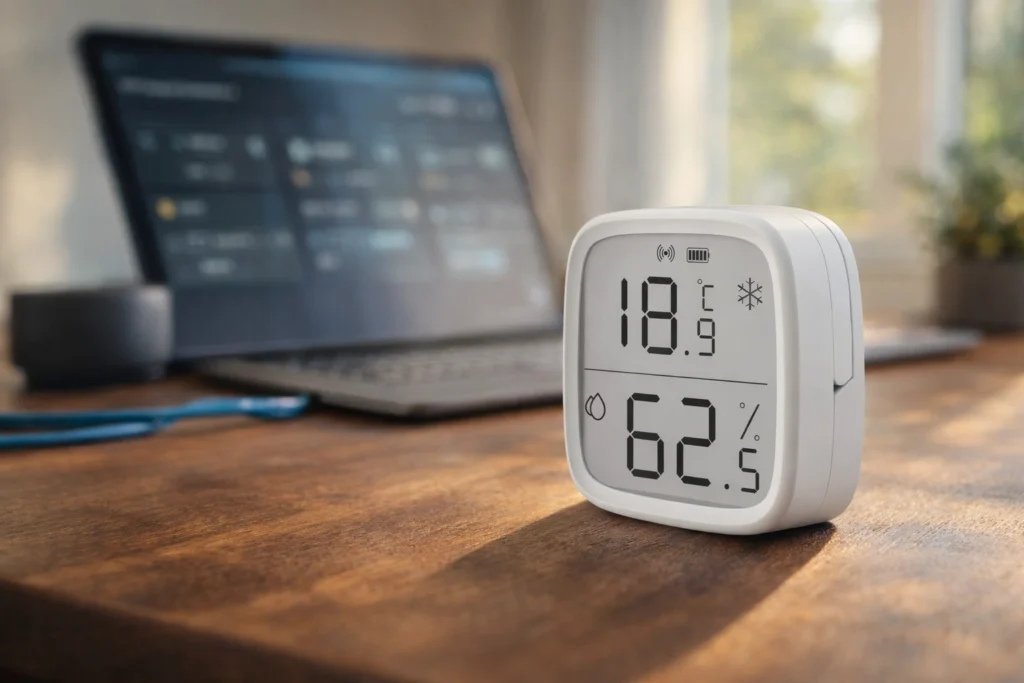
At first glance, the SNZB-02D is a simple device, but its specs are more than enough for most home applications. Its large LCD screen is a key differentiator, letting you see the data at a glance without having to pull out your phone or check a dashboard.
| Feature | Specification |
| Protocol | Zigbee 3.0 |
| Display | 2.5-inch LCD |
| Sensor | High-Precision Swiss-made Sensor |
| Temp. Accuracy | ±0.2°C (±0.36°F) |
| Humidity Accuracy | ±2% RH |
| Battery | CR2450 (3V) |
| Mounting | Kickstand, magnet, 3M adhesive |
The cloud data storage Sonoff offers through its eWeLink app is a nice touch, but for us Home Assistant users, it’s irrelevant. We’ll be managing all historical data locally thanks to the Recorder integration.
Home Assistant Integration: Zigbee2MQTT vs. ZHA
The real magic happens when you bring this sensor into Home Assistant locally. Forget the eWeLink app and its cloud dependencies. To do this, you’ll need a Zigbee coordinator, like the popular SMLIGHT SLZB-06, and you’ll need to choose between the two major integration methods.
My Recommendation: ZHA vs. Zigbee2MQTT
In 2026, both options are incredibly stable and mature, but they cater to slightly different users:
- ZHA (Zigbee Home Automation): This is Home Assistant’s native solution. It’s easier to set up (“plug and play”) and is perfectly integrated into the UI. If you want simplicity and don’t want to mess with extra software, ZHA is a fantastic choice and is 100% compatible with the SNZB-02D.
- Zigbee2MQTT: This is my personal pick and what I recommend for power users who want maximum control. It requires installing an extra add-on (the MQTT broker) but offers massive device compatibility, more granular configuration options per device (force remove, advanced renaming, etc.), and a powerful dedicated web UI for managing your Zigbee network.
In either case, pairing is as simple as putting the sensor in pairing mode (press and hold the back button for 5 seconds) and enabling joining for new devices in ZHA or Zigbee2MQTT. Within seconds, you’ll have temperature and humidity entities ready to use in Home Assistant.
The 2026 Ecosystem: What About Matter Integration?
Let’s be clear: the Sonoff SNZB-02DAffiliate link is a Zigbee device. It does not natively support Thread or Matter. However, that doesn’t mean it can’t be part of a Matter ecosystem. Thanks to the magic of Home Assistant, your instance can act as a Matter bridge.
This means you can “expose” your Zigbee Sonoff sensor to other Matter-compatible platforms (like Apple Home, Google Home, etc.) through Home Assistant. So, while the device itself doesn’t speak the language, your smart home hub acts as a translator, giving it a second life and interoperability it never had out of the box.
Showdown: Sonoff SNZB-02D vs. Aqara Alternatives in 2026
Sonoff’s main rival in this space has always been Aqara. In 2026, the comparison is still relevant, though now there are more players in the game, including new native Thread devices.
| Feature | Sonoff SNZB-02DAffiliate link | Aqara T1 | Aqara P2 (Context) |
|---|---|---|---|
| Display | Yes, 2.5″ LCD | No | N/A (P2 are door/window sensors) |
| Protocol | Zigbee 3.0 | Zigbee 3.0 | The P2 product line uses Thread natively. |
| Estimated Price | ~$12-15 | ~$15-20 | Generally more expensive (~$25-30). |
| Best for… | The best value for a sensor with a screen. | A more compact and discreet sensor, no screen needed. | Building a future-proof, native Thread network. |
As you can see, the SNZB-02D still wins on price and functionality if you value a built-in display. The Aqara P2 sensor, while a different type of device, represents the new generation of Thread devices that compete in a different ecosystem but will ultimately coexist with Zigbee thanks to bridges.
Your IoT Network Security: A Crucial Note
One of the biggest advantages of using Zigbee devices like the SNZB-02D is the inherent security of operating on a separate, local network. Unlike many cheap Wi-Fi gadgets, this sensor doesn’t need to phone home to the internet to work, drastically reducing its attack surface.
For even tighter security, I always recommend you segment your home network. Isolating your IoT devices on their own VLAN (Virtual Local Area Network) is a best practice that ensures that even if one device were compromised, it couldn’t access the rest of your main network (your computers, NAS, etc.).
Price & Where to Buy (With a Discount)
As of 2026, the Sonoff SNZB-02D remains an incredibly affordable option, typically hovering around the $12-15 mark. It’s one of those products you can buy in bulk to deploy all over the house without breaking the bank.
Also, remember that as a reader of this blog, you get a 10% discount at the official ITEAD (Sonoff) store by using the coupon code: TECNOYFOTO.
Sonoff SNZB-02D Review 2026: The Final Verdict
The Sonoff SNZB-02D is proof that the newest gadget isn’t always the best tool for the job. In 2026, it’s still my number one recommendation for anyone who needs a cheap, reliable temperature and humidity sensor with a screen that integrates flawlessly and locally with Home Assistant.
It’s a true workhorse: you set it up once and forget about it for months. Its compatibility with both ZHA and Zigbee2MQTT is bulletproof, and its ability to be exposed to Matter via Home Assistant gives it a future-proof lifespan that will extend for years to come. If you’re just starting out or just need to monitor one more room, you can’t go wrong with this one.
Working with 120V/240V main electrical wiring and breaker panels is extremely dangerous. If you are not qualified, always consult a licensed electrician. The information provided on this blog is for educational purposes and based on my own experience; you are solely responsible for any modifications you make to your own electrical systems.
Continue reading
Next related guide · 6 min read
SONOFF SNZB-06P in 2026: Is This Budget Presence Sensor Still a Must-Buy?
Last updated on March 8, 2026 In the fast-paced world of smart homes, some devices become classics for their sheer reliability and value. The…
Continue with this article