
This article may contain affiliate links. If you buy through these links, the price is the same for you and the store pays me a small commission that helps keep Tecnoyfoto running.

Last updated on February 24, 2026
Launched way back in 2023, the SONOFF MINIR4 was a game-changer in the smart relay world thanks to its incredibly tiny size and powerful ESP32 chip. But in a 2026 smart home ecosystem that now revolves around Matter and low-power protocols like Thread and Zigbee, does this little Wi-Fi device still have a place? In this SONOFF MINIR4 Review 2026, we’ll break down its long-term performance, reliability, and most importantly, how it masterfully integrates with a smart home brain like Home Assistant to remain a surprisingly relevant choice.
Is the SONOFF MINIR4 Still Worth It in 2026?
The short answer: absolutely, but only for the right job. After several years on the market, the MINIR4 has proven itself to be an extremely reliable workhorse. Its greatest strength—and its main weakness in 2026—is its connectivity: it runs exclusively on 2.4 GHz Wi-Fi. This means you don’t need a Zigbee coordinator or Thread hub, but it also means you miss out on the speed and robustness of mesh networking.
In my experience, it’s the perfect choice for isolated spots in your home where Zigbee coverage might be weak, but your Wi-Fi signal is strong. Think about it: the garage door opener, the pool pump out in the yard, or that one light in the back of the shed. For these use cases, its proven reliability and rock-bottom price make it a no-brainer.
Key Technical Specs (From a 2026 Perspective)
While the market has evolved, the MINIR4’s specs are still solid for its intended purpose:
- ESP32 Chip: It’s still a very capable and secure dual-core processor, ensuring snappy responses and stable operation—something I can vouch for after years of continuous use.
- Ultra-Compact Size: While it no longer holds the title of “the smallest,” it remains one of the most compact relays available, fitting easily into most electrical boxes, even crowded ones.
- “Detach Relay” Mode: This feature is still a killer. It allows the physical switch and the internal relay to operate independently. This is a game-changer for smart bulbs, where you want the wall switch to control the bulb via Home Assistant without ever cutting its power.
- Switch Compatibility: It flawlessly supports momentary switches, standard toggle switches, three-way switches (SPDT), and dry contact sensors, giving it enormous versatility.
- eWeLink-Remote: This is Sonoff’s proprietary local control protocol. It lets you pair the MINIR4 with remotes like the R5 or wireless switches like the S-MATE, which continue to work even if your Wi-Fi goes down. A very welcome touch of added reliability.
The Elephant in the Room: The MINIR4’s Matter Support
Let’s be blunt: the SONOFF MINIR4 does not have native Matter-over-Thread support. Its sibling, the MINIR4M, was one of Sonoff’s early forays into the Matter world, but the standard has since matured and now primarily focuses on the Thread protocol for this class of device.
However, this is where the magic of Home Assistant comes in. Thanks to the open architecture of Home Assistant, we can integrate the MINIR4 and then “expose” it to other ecosystems as if it were a native Matter device. This allows us to control it from Apple Home, Google Home, or Alexa, with Home Assistant acting as a universal bridge. In 2026, this is the most powerful way to breathe new life and extended compatibility into proven Wi-Fi devices. For a full guide on this, check out our article on Home Assistant & Matter Integration.
SONOFF MINIR4 Home Assistant Integration: Your 2026 Options
For me, a Sonoff device only reaches its true potential when you pull it out of the eWeLink cloud and bring it into your local network. Today, these are the best ways to get it done for a Home Assistant integration:
- Sonoff LAN (via HACS): This is, without a doubt, the best option for most users. It’s a custom integration installed via HACS that gives you 100% local control over the MINIR4, as long as it’s on the same network as your Home Assistant server. The response is instant, and you have zero dependency on Sonoff’s cloud. It even allows you to update the device’s firmware directly from Home Assistant.
- eWeLink Integration (Official): This is the simplest route if you don’t want to mess with HACS. You configure it from the Home Assistant UI, but all commands are routed through eWeLink’s servers. This introduces a slight delay and means you lose control from HA if your internet goes down. I only use this as a backup method.
- Flashing with ESPHome: The choice for advanced tinkerers. It involves opening the device and flashing custom firmware. This gives you absolute, granular control over every aspect of the relay. However, with the rock-solid reliability of the Sonoff LAN integration, it’s honestly not as necessary as it was a few years ago. It’s an option, but I wouldn’t recommend it unless you have a very specific use case. If you’re curious about this world, you can learn more about it on the official ESPHome site.
Wiring Diagram and Installation Gotchas
The wiring diagram for the MINIR4 is straightforward, but there’s one critical point to remember: it requires a Neutral wire to function. This is non-negotiable, and you absolutely must confirm you have a neutral wire in your electrical box before buying one.
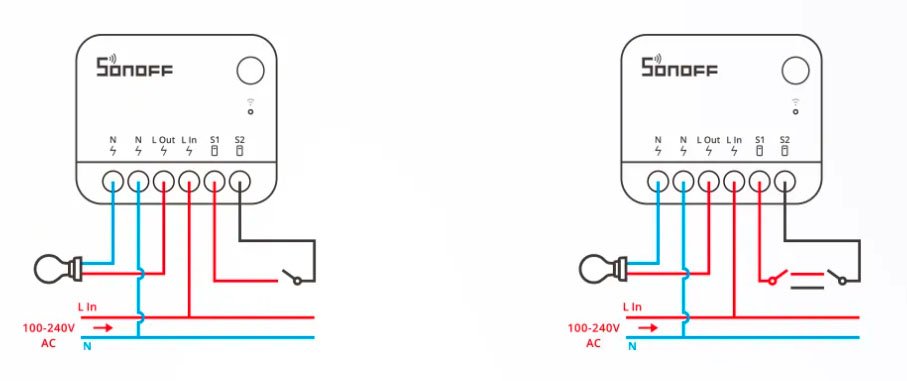
If you don’t have a neutral wire available, you’ll need to look at other solutions like the SONOFF ZBMINIL2, which remains one of the best no-neutral Zigbee alternatives on the market today.
Head-to-Head: SONOFF MINIR4 vs. 2026 Alternatives
To put things in perspective, here’s how the MINIR4 stacks up against the conceptual successors that have embraced Zigbee and Thread in recent years.
| Feature | SONOFF MINIR4 (2023) | SONOFF MINIR5 (Zigbee) | SONOFF MINIR6 (Thread) |
|---|---|---|---|
| Protocol | Wi-Fi 2.4 GHz | Zigbee 3.0 | Thread (Native Matter) |
| Hub Required | No (for basic use) | Yes (Zigbee Coordinator) | Yes (Thread Border Router) |
| Best For… | Isolated spots with good Wi-Fi. Budget-conscious projects. | Dense, robust smart home networks using Zigbee2MQTT or ZHA. | Future-proof, 100% Matter-native ecosystems. |
| HA Integration | Excellent (via Sonoff LAN) | Native (via ZHA/Z2M) | Native (via Matter integration) |
Price and Where to Buy for Less
One of the biggest advantages of a mature product is its price. As of 2026, the SONOFF MINIR4 can be found for around $9-12, making it an absolute bargain for adding smarts to any switch.
And don’t forget, as one of our readers, you get an extra perk: you can score a 10% discount at the official ITEAD store by using the coupon code TECNOYFOTO at checkout.
Conclusion: My Verdict After Years of Use
The SONOFF MINIR4 is like a trusty old pickup truck: it’s not the latest tech, but you know it’ll never let you down. I’ve had one running the lights in my garage and another controlling a decorative water pump in the garden for years, and their performance has been flawless.
For a brand-new, whole-house installation, I’d probably opt for its Zigbee or Thread-based siblings to build a more robust mesh network. However, for specific projects, expanding an existing setup, or for anyone looking for a proven, low-cost Wi-Fi solution, the MINIR4 is still an undisputed champion in 2026—especially if you’re pairing it with Home Assistant to unlock its full, local-control potential.
Working with 120V/240V AC electrical wiring carries a serious risk of injury or death. If you are not qualified or comfortable with this work, always consult a licensed electrician. The information provided on this site is for educational purposes based on my own experience; you are solely responsible for any modifications you make to your electrical systems.
Continue reading
Next related guide · 8 min read
SONOFF SNZB-06P24 In-Depth Review (2026): The mmWave Sensor That *Actually* Works?
Updated on July 21, 2026 The SONOFF SNZB-06P24 is making waves as a revolutionary Zigbee presence sensor. It uses 24GHz radar to detect not…
Continue with this article