

Updated January 23, 2026
What is True RMS and Why Is It a Must-Have in 2026?
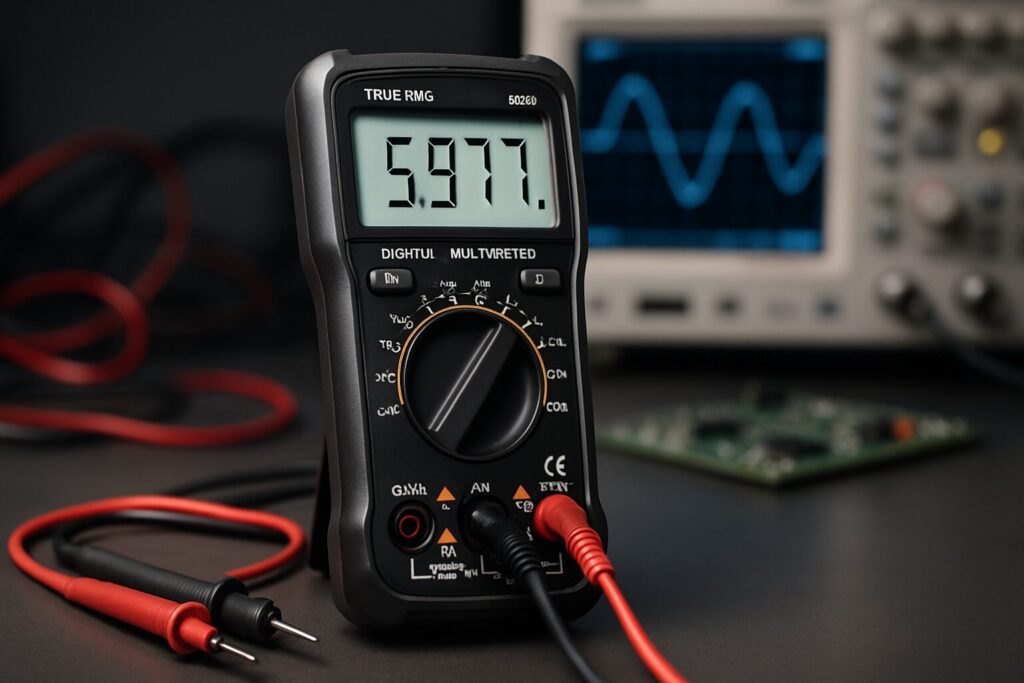
If you’re an electrical pro, an HVAC technician, or a serious electronics hobbyist, you’ve probably heard the term “True RMS.” But do you really know what True RMS is and why, in 2026, it’s no longer an optional feature but an absolute necessity? Put simply, a True Root Mean Square (True RMS) meter is the only tool that guarantees accurate AC voltage and current measurements in modern electrical circuits.
To grasp its importance, we first need to understand the two types of AC waveforms we encounter every single day.
Clean vs. Dirty Power: Sine Waves vs. Non-Sinusoidal Waves
Classic electrical theory is built on perfect waveforms, but the reality inside our walls is a lot messier.
- Pure Sine Waves: This is the ideal AC waveform—clean, symmetrical, and free of distortion. It’s what a power plant generator produces and what simple “linear” loads like old-school induction motors or incandescent light bulbs consume.
- Non-Sinusoidal Waves: This is the new normal in 2026. These are distorted, deformed waves with irregular peaks, sharp cliffs, or square and sawtooth shapes. This distortion is caused by “non-linear” loads, which draw current in short pulses instead of a smooth, continuous flow.
The explosion of modern electronics has flooded our electrical systems with these complex waves, making it critical to accurately measure non-sinusoidal AC current.
Average-Responding vs. True RMS: The Accuracy Showdown
This is the heart of the matter. Both a standard “average-responding” meter (often misleadingly labeled just “RMS”) and a True RMS multimeter can measure a pure sine wave with acceptable accuracy. The problem rears its head when the waveform is distorted.
- An average-responding meter uses a simplified mathematical shortcut. It calculates the average of the rectified wave and multiplies it by a correction factor (1.11) to *estimate* the RMS value. This ONLY works for pure sine waves.
- A True RMS meter uses a much more sophisticated electronic circuit and algorithm. It calculates the *actual* heating value of the waveform using the complete Root Mean Square formula, allowing it to accurately measure ANY type of waveform you throw at it.
The difference between an average-responding meter and a True RMS meter can result in wildly inaccurate readings. These errors can lead to misdiagnosed problems, overloaded circuits, overheated wires, and nuisance tripping from protective devices like a circuit breaker.
Comparison Chart: Average-Responding vs. True RMS
| Feature | Average-Responding Meter (RMS) | True RMS Meter |
|---|---|---|
| Accuracy on Sine Waves | High | High |
| Accuracy on Non-Sinusoidal Waves | Low (Errors up to 40%) | Very High |
| Technology | Simplified, averaging math formula. | Advanced circuit calculates the true heating value of the signal. |
| Cost (2026 Estimate) | Cheaper ($20-$50) | Slightly higher, but very accessible ($50 and up) |
| Best For… | Simple resistive circuits and basic educational tasks. | Any modern professional or home environment, especially with power electronics. |
Real-World Scenarios: When You Absolutely Need a True RMS Multimeter in 2026
In my daily work, the question isn’t “if” I need a True RMS meter, but “where could I possibly work without one?” If you’re dealing with any of these systems, a True RMS meter is non-negotiable:
- Variable Frequency Drives (VFDs): Used to control motor speeds in industrial machinery, conveyor belts, and pump systems. Their output is a very complex pulsed waveform.
- Switching Mode Power Supplies (SMPS): Found in computers, TVs, phone chargers, and virtually every modern electronic device.
- LED Lighting & Electronic Ballasts: The drivers that power LED lights and modern fluorescent bulbs are classic non-linear loads.
- HVAC Systems: Modern inverter air conditioners and high-efficiency furnaces rely heavily on power electronics.
- Electric Vehicle (EV) Charging Stations: EV chargers are a significant source of harmonic distortion on a home’s electrical system.
- Smart Home & Automation Gear: Controllers, dimmers, and power supplies for systems like Home Assistant generate non-sinusoidal waveforms.
My Top True RMS Multimeter Picks for 2026
The good news is that in 2026, True RMS technology is more affordable than ever. Here are my go-to recommendations based on your needs:
- Top-Tier (Heavy-Duty Pro): Fluke 87V MAX
This is the industry gold standard for a reason. It’s incredibly rugged (IP67 rated), ridiculously accurate, and built to last. If your livelihood depends on precise measurements in the toughest environments, this is a bulletproof investment. Expect to pay in the $500-$700 range. - Mid-Range (Pro & Serious Hobbyist): Klein Tools CL800
This True RMS Clamp Meter offers an outstanding balance of features and value. It measures voltage, current, resistance, capacitance, and temperature. It’s the all-in-one workhorse I recommend for most electricians. It typically runs between $150-$250. - Budget-Friendly (DIY & Home Gamer): LOMVUM T28C
For those just starting out or for the home toolbox. It offers True RMS, a backlit display, and all the basic measurements with surprisingly good accuracy for its price. It’s a fantastic option that doesn’t sacrifice precision for the sake of budget. You can usually find it for around $40-$70. You can see more about it in my full review of the LOMVUM T28C.
Frequently Asked Questions (FAQ) about True RMS
Don’t True RMS meters cost a lot more?
Historically, yes. The complex circuitry made them significantly more expensive. In 2026, however, the price gap has shrunk dramatically. Entry-level True RMS models are very affordable, making the small extra investment (often just $20-$30 more than a basic meter) completely worth it for the safety and reliability you gain.
Can I just use a standard average-responding meter for everything?
You could, but only on a very simple circuit, like an electric heater with a pure resistive load. The second you try to measure a circuit with any electronics—a computer, an LED light, a motor with a VFD—your reading will be wrong. You could be making dangerous decisions based on false data.
What happens if I measure a non-sinusoidal wave with an average-responding meter?
You will get an inaccurate reading, period. The Fluke 87V’s own manual states that an average-responding meter can read as much as 40% low or 10% high. This could lead you to believe a circuit is fine when it’s actually overloaded, or vice-versa.
Are all clamp meters sold in 2026 True RMS?
No, definitely not. Manufacturers still sell cheaper, average-responding models, especially at the low end of the market. It is crucial to always look for the “True RMS” specification on the product packaging or description before buying.
The Bottom Line: An Investment in Accuracy and Safety
In the electrical landscape of 2026, where non-linear loads dominate our homes and workplaces, a True RMS multimeter or clamp meter is no longer a luxury—it’s a fundamental piece of equipment. Investing in a True RMS device is an investment in the accuracy of your diagnostics and, more importantly, in the safety of your work and the systems you service. When in doubt, my advice is simple: always choose True RMS.