
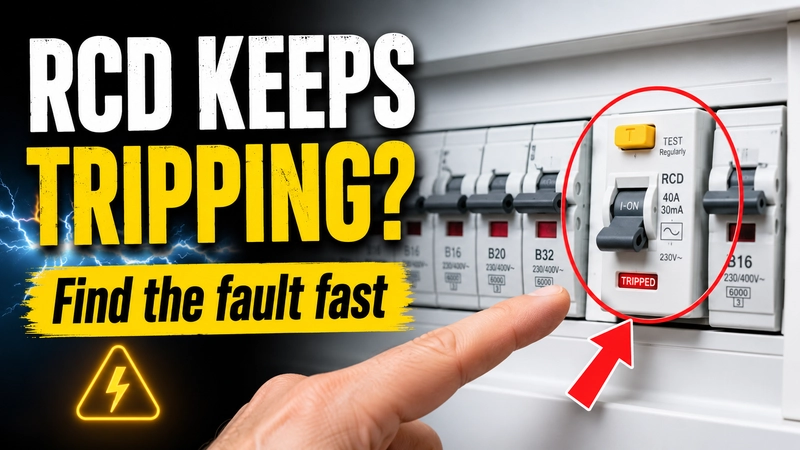

If your RCD keeps tripping, repeatedly resetting it is not the solution. An RCD trips because it has detected an imbalance that may indicate current leaking away from the intended circuit.
Sometimes the cause is simple, such as a faulty appliance or moisture in outdoor equipment. Other cases involve damaged wiring, cumulative leakage from several electronic devices, a neutral-to-earth fault, or a problem that requires proper electrical test equipment to diagnose.
In this guide we’ll work through the problem logically: first understanding what has actually tripped, then narrowing down the affected circuit or appliance without opening the electrical panel or touching fixed wiring.
This article covers RCDs, RCCBs and RCBOs commonly found in Europe and the UK. North American GFCIs use different terminology, standards and trip characteristics.
If your GFCI keeps tripping, read our dedicated North American GFCI troubleshooting guide.
What Is an RCD and What Does It Protect?
RCD stands for Residual Current Device. It is a general term for devices designed to disconnect the supply when they detect residual current flowing somewhere it should not.
In simple terms, the device compares the current flowing through the live conductors with the current returning through them. Under normal conditions those values balance. If some current takes another path — potentially through earth, damaged insulation, moisture, or a person — the RCD can disconnect the circuit.
RCD protection complements other protective devices. It does not mean that overload and short-circuit protection are no longer necessary.
RCD, RCCB and RCBO: What’s the Difference?
These terms are often mixed together, but they do not mean exactly the same thing.
| Device | What it does | Typical role |
|---|---|---|
| RCD | General family name for residual-current protection. | Umbrella term. |
| RCCB | Detects residual current but does not provide normal overload or short-circuit protection by itself. | May protect several circuits together with separate MCBs. |
| RCBO | Combines residual-current protection with overload and short-circuit protection. | Usually protects one individual circuit. |
This distinction becomes very useful when troubleshooting.
If one RCBO trips, you already know which circuit has the problem. If one RCCB protects several circuits and trips, you may need to determine which of those circuits is responsible.
Why Does an RCD Keep Tripping?
There isn’t one single cause. These are some of the most common possibilities.
1. A Faulty Appliance
An appliance can develop an insulation fault that allows current to leak toward earth.
Heating elements are a classic example, which means appliances such as washing machines, dishwashers, ovens and water heaters can sometimes produce this kind of fault. Motors, power supplies and other components can also fail.
2. Moisture or Water Ingress
Outdoor sockets, garden equipment, garages, utility areas, exterior lighting and damp locations deserve particular attention.
A fault that appears after heavy rain or during periods of high humidity can be an important clue, although the actual cause still needs to be diagnosed correctly.
3. Damaged Fixed Wiring
A damaged cable, crushed insulation, poorly made connection or other fault in the fixed installation can also produce residual current.
If the affected circuit continues to trip with all accessible appliances unplugged, fixed wiring becomes one of the possibilities that needs professional investigation.
4. Neutral-to-Earth Faults
Neutral-to-earth faults can produce symptoms that are more confusing than a simple faulty appliance.
They can sometimes make an RCD trip only when another load is operating, and simply switching off an MCB does not always fully isolate every possible neutral-related problem.
This is one reason why the basic isolation procedure in this article can narrow down a fault but cannot replace proper electrical testing.
5. Cumulative Leakage
Modern electronic equipment can have small amounts of normal leakage current.
One device may not cause a problem, but several computers, appliances, LED drivers, filters, chargers and other electronic loads connected behind the same RCD can contribute leakage at the same time.
If the total becomes high enough, the RCD may trip even though there is no single spectacular fault to find.
6. The RCD Type May Not Suit the Load
Modern electrical equipment does not always produce a simple sinusoidal AC residual current.
Electronic power supplies, variable-speed drives, inverter appliances, photovoltaic systems and EV charging equipment can introduce different residual-current waveforms or DC components.
That is why modern installations distinguish between several RCD types.
RCD Types AC, A, F and B Explained
This is where it is particularly important not to confuse European RCD terminology with North American GFCI terminology.
RCD Type A is not the same thing as a North American Class A GFCI.
| RCD type | Residual currents it is designed to detect | Typical context |
|---|---|---|
| Type AC | Sinusoidal alternating residual current. | Older/basic loads where DC components are not expected. |
| Type A | AC plus pulsating DC residual current. | Common modern household electronic loads. |
| Type F | Type A capability plus residual currents containing mixed-frequency components. | Certain single-phase equipment using frequency-controlled drives or inverters. |
| Type B | Broad residual-current detection including smooth DC. | Special applications such as certain EV charging, PV and inverter installations. |
The correct type depends on the equipment, installation design, manufacturer instructions and the electrical rules applicable in your country.
In the UK, current wiring rules significantly restrict where Type AC devices are appropriate because modern loads can contain DC components. Elsewhere in Europe, requirements are defined through national electrical rules and implementations of the relevant European and IEC standards.
Do not replace an RCD simply by choosing a “higher” type from this table. Selection is part of the electrical design and should take account of the actual circuit and connected equipment.
What Does 30 mA Mean?
You’ll frequently see 30 mA printed on domestic RCDs and RCBOs.
That value is the rated residual operating current of the device. RCDs with a rating not exceeding 30 mA are widely used where additional protection against electric shock is required.
However, not every RCD in every electrical installation is necessarily a 30 mA device. Higher-rated or time-delayed RCDs can have different functions within an installation.
The exact protection required depends on the circuit, location, installation arrangement and national rules.
Step by Step: How to Find Why Your RCD Is Tripping
Step 1: Identify What Actually Tripped
First determine whether you have:
- one RCBO protecting a single circuit,
- an RCCB/RCD protecting several MCBs,
- or another protective device that has actually tripped.
Do not assume every switch in the consumer unit is an RCD.
Step 2: Think About What Happened Immediately Before the Trip
Useful clues include:
- an appliance starting,
- the washing machine beginning to heat water,
- an oven or dishwasher turning on,
- heavy rain,
- outdoor lighting switching on,
- an EV beginning to charge,
- or a fault appearing after new equipment was connected.
The timing of the trip can sometimes tell you more than repeatedly resetting the device.
Step 3: Unplug Accessible Appliances
Unplug portable appliances and other easily accessible equipment connected to the affected circuit or circuits.
Do not dismantle fixed equipment or remove sockets from the wall.
Step 4: If One RCD Protects Several Circuits, Isolate Them
If an RCCB protects a group of MCBs, and the consumer unit is intact and safe to operate normally, switch those downstream circuit breakers off using their normal handles.
Try resetting the RCD once.
If it resets, switch the circuits back on one at a time.
If the RCD trips when one particular circuit is restored, leave that circuit switched off. You have narrowed down the problem considerably.
This is a diagnostic clue, not proof of the exact fault.
Step 5: Check Appliances on the Suspect Circuit
With accessible appliances unplugged, restore the circuit and see whether the RCD remains on.
If it does, reconnect the appliances one at a time.
If one device consistently causes the RCD to trip, stop using that appliance until it has been properly inspected or repaired.
Step 6: If It Still Trips with Appliances Unplugged, Stop
If the circuit still causes the RCD to trip with the accessible loads unplugged, the fault may involve fixed wiring, permanently connected equipment, moisture, insulation failure, or a neutral-to-earth problem.
At this point an electrician can carry out insulation-resistance measurements, leakage-current tests and other checks that cannot be reproduced safely just by operating switches.
What If the RCD Won’t Reset Even with the Circuits Switched Off?
Do not keep forcing it back on.
Possible causes include a fault that has not been isolated by the circuit breakers, a neutral-to-earth problem, fixed wiring, permanently connected equipment, or the RCD itself.
This needs proper diagnosis by a qualified electrician.
The RCD Trips Only Occasionally
Intermittent faults can be more difficult to find than a device that trips immediately every time.
Try noting:
- the exact time it trips,
- which appliances were operating,
- whether heating elements had just started,
- whether it was raining,
- whether an EV or battery system had started charging,
- and whether the problem occurs at a similar point in an appliance cycle.
A simple record can reveal a pattern that is otherwise easy to miss.
Can Too Many Devices Make an RCD Trip?
Potentially, yes — but not because the RCD is being overloaded in the same way as a circuit breaker.
Multiple electronic devices can each contribute a small amount of leakage current. The combined leakage behind one RCD can become significant enough to cause unwanted tripping or leave too little margin for a temporary increase.
This is one reason why modern installations often use multiple RCDs or individual RCBOs rather than placing a large part of the house behind one residual-current device.
If cumulative leakage is suspected, it should be measured rather than guessed.
What About EV Chargers, Solar Inverters and Heat Pumps?
These loads deserve special treatment because power electronics can produce residual-current components different from those of simple resistive appliances.
Do not automatically assume that an EV charger requires a Type B RCD.
Some charging equipment includes its own detection for DC residual current, which can change the RCD requirements upstream. Other installations may require Type A, F or B protection depending on the equipment and applicable rules.
The correct solution comes from the charger or inverter manufacturer’s instructions and the electrical design — not from choosing the most expensive RCD type.
Should I Test the RCD Test Button?
Yes.
The built-in Test or T button creates an internal imbalance to verify that the RCD mechanism can operate.
Follow the testing interval printed on the device, specified by its manufacturer, or required by the rules applicable in your country.
For example, current UK guidance associated with BS 7671 calls for routine operation of the test button every six months, while some manufacturers may specify a different interval.
If pressing the test button does not trip the device, do not assume you are protected. Have the installation checked.
The test button is useful, but it is not equivalent to the instrument testing carried out by an electrician.
When Should You Call an Electrician?
Stop troubleshooting and get professional help if:
- the RCD will not reset,
- it trips with accessible appliances unplugged,
- you suspect a fault in fixed wiring,
- there are signs of overheating, burning, water ingress or physical damage,
- the consumer unit itself appears damaged,
- the problem involves an EV charger, solar inverter or other high-power permanently connected equipment and the cause is unclear,
- or you would need to remove covers or touch wiring to continue diagnosing the problem.
A qualified electrician can measure insulation resistance and residual current, identify neutral-to-earth faults, test the RCD correctly and determine whether the installed protective device is appropriate for the circuit.
Frequently Asked Questions
Why does my RCD trip when I turn on the washing machine?
A fault inside the washing machine is one possibility, particularly if the trip happens during a specific part of the cycle such as water heating. Do not assume the machine is definitely responsible, but stop using it if it consistently reproduces the fault and have it checked.
Why does my RCD trip when it rains?
Moisture entering outdoor sockets, lights, junction boxes or other equipment is one possible cause. Leave the affected circuit or equipment isolated and have it inspected rather than repeatedly resetting the RCD.
Can an RCD itself become faulty?
Yes. Protective devices are not immune to failure. However, the fact that an RCD trips does not automatically mean the RCD is defective. The installation should be tested before replacing it.
Is Type A better than Type AC?
Type A can detect residual-current waveforms that Type AC is not designed to detect and is much more suitable for many modern electronic loads. But the correct device must still be selected according to the circuit, equipment, manufacturer instructions and applicable electrical rules.
Is Type B always best?
No. Type B is designed for applications where its wider residual-current detection capability is required. Installing one everywhere is not a substitute for proper circuit design.
Does a 30 mA RCD replace the circuit breaker?
Not necessarily. An RCCB provides residual-current protection but does not replace the required overcurrent protection. An RCBO combines both functions in one device.
Conclusion
When an RCD keeps tripping, the most useful thing you can do is stop treating the trip itself as the problem.
The RCD is giving you information.
By identifying which protective device has operated, unplugging accessible loads and isolating circuits using only their normal controls, you can often narrow the problem down to one circuit or appliance without touching any wiring.
But there is also a clear point where DIY troubleshooting should end. Fixed-wiring faults, neutral-to-earth faults, insulation problems and questions about the correct RCD type require proper test equipment and electrical knowledge.
And if you’re actually dealing with a North American GFCI rather than a European-style RCD, remember that the terminology and standards are different. You can continue with our GFCI keeps tripping troubleshooting guide for the United States and Canada.
Continue reading
Next related guide · 7 min read
Why Your GFCI Keeps Tripping: A Complete 2026 Troubleshooting Guide
Updated on August 18, 2026 ⚠️ SAFETY WARNING: Working with electricity can be extremely dangerous. Never remove electrical panel covers, touch exposed wiring, or…
Continue with this article