

Updated on August 18, 2026
What is a GFCI and Why Is It Your Home’s Lifesaver?
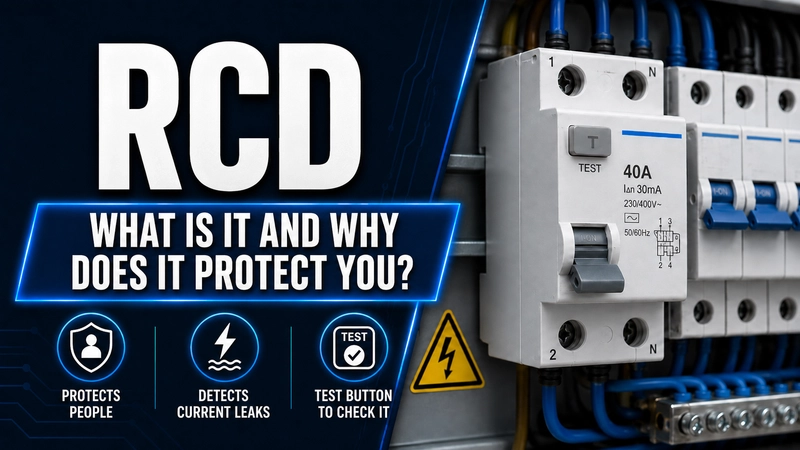
A GFCI (Ground Fault Circuit Interrupter) is one of the most important electrical safety devices in your home for protecting people. If your GFCI keeps tripping, don’t simply keep resetting it. Its mission is simple but vital: detect a ground fault—a small, potentially dangerous leakage of electrical current—and shut off the power extremely quickly to reduce the risk of severe electric shock.
You’ll commonly find GFCI protection in bathrooms, kitchens, garages, outdoor areas, and other locations where electricity and moisture may come together. GFCI receptacles have characteristic “Test” and “Reset” buttons, while GFCI circuit breakers normally have a Test button and a breaker handle. Testing the device regularly is an important part of making sure the protection is still working correctly.
This guide focuses on GFCIs used in the United States and Canada. European electrical installations normally use RCDs, RCCBs and RCBOs, with different terminology and classifications.
If your RCD keeps tripping, read our dedicated European and UK RCD troubleshooting guide.
GFCI vs. Standard Circuit Breaker: Who Protects What?
It’s a common mistake to confuse a GFCI with a standard circuit breaker. Understanding the difference is fundamental to your home’s safety:
- GFCI (Ground Fault Circuit Interrupter): Primarily protects people. It detects very small differences between the current going out and the current returning through the circuit and quickly disconnects power when a ground fault is detected.
- Standard Circuit Breaker: Protects the wiring and circuit against excessive current caused by overloads or short circuits, helping prevent overheating and fire.
The National Electrical Code (NEC) requires GFCI protection in specific locations and applications, while circuits also require appropriate overcurrent protection. These are different safety functions. A GFCI receptacle does not replace the circuit breaker protecting the branch circuit, although a GFCI circuit breaker can combine ground-fault protection and overcurrent protection in the same device.
How a GFCI Works: The Tech Behind the Trip
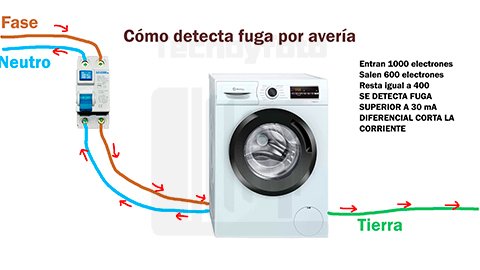
A GFCI’s operation is based on a beautifully simple physics principle. Inside, a small sensor constantly monitors the amount of current flowing out on the hot wire and returning on the neutral wire.
- Normal Operation: The current going out is essentially equal to the current coming back. The GFCI detects no significant imbalance and stays on.
- Ground Fault Scenario: If an appliance, cable, tool, or other electrical equipment develops a fault, some current may take an unintended path instead of returning through the neutral conductor. In a dangerous situation, that path could even include a person’s body.
- Detection and Trip: A Class A GFCI used for personnel protection in North America is designed to respond to a very small imbalance. The operating range is approximately 4-6 milliamps (mA), and a GFCI can interrupt the circuit in as little as 1/40th of a second.
This extremely fast response is what makes GFCI protection so important in locations where an electrical ground fault could expose someone to electric shock.
Types of GFCIs in 2026: Not All Are Created Equal
One important clarification is necessary here because North American GFCI terminology is sometimes confused with European RCD terminology.
For normal residential protection of people in the United States and Canada, the key term is Class A GFCI. Under the North American system, a Class A GFCI is designed to trip when ground-fault current reaches approximately 4-6 mA.
You may also encounter different physical forms of GFCI protection:
- GFCI Receptacle: The familiar outlet with TEST and RESET buttons. It can protect the receptacle itself and, when wired correctly, additional downstream outlets.
- GFCI Circuit Breaker: Installed in the electrical panel and able to provide GFCI protection for an entire branch circuit while also providing the normal overcurrent protection of a circuit breaker.
There are also special-purpose GFCI classes for particular applications and voltages, but these are not the same as the Type AC, Type A, Type F and Type B classifications used for RCDs in IEC-based electrical systems.
Class A GFCI and Type A RCD are not equivalent classifications. If you are working with a European electrical installation, use the dedicated RCD guide linked near the beginning of this article.
For a residential GFCI, also pay attention to the device’s voltage, current rating and intended application. Common residential branch circuits in the U.S. are 15A or 20A, but receptacle ratings and feed-through ratings must be considered according to the device listing and the circuit where it is installed.
Why Your GFCI Keeps Tripping: Common Causes & Solutions
If a GFCI suddenly trips, it’s not a random event. Something caused the device to detect an imbalance. Here are some of the most common possibilities:
- Faulty Appliance: An appliance can develop an insulation fault or another internal problem that allows current to take an unintended path. Heating elements, motors, compressors, power supplies and damaged cords can all be possible sources.
- Moisture Intrusion: Water getting into outdoor receptacles, junction boxes, poorly sealed equipment, or other electrical components can create a leakage path and cause a GFCI to trip.
- Damaged Wiring: A damaged, pinched, deteriorated, or improperly connected conductor can create a ground fault. If the problem appears to be in fixed wiring, stop troubleshooting and call a qualified electrician.
- Cumulative Leakage or Intermittent Faults: Some electronic equipment can contribute small amounts of leakage current during normal operation. Several devices on the same protected circuit, or an intermittent fault in one device, can sometimes make the cause harder to identify. If repeated tripping has no obvious source, the circuit should be properly tested rather than bypassing or replacing the GFCI with a different type of protection.
Step-by-Step Guide: How to Reset a GFCI and Find the Fault
A tripping GFCI can be frustrating, but a methodical approach can often help you identify whether the problem is related to an appliance or requires professional diagnosis. Use only normal user-accessible controls and never remove electrical covers or touch wiring.
- Attempt One Reset: If there are no signs of water, burning, overheating, physical damage, or another obvious hazard, press the GFCI receptacle’s RESET button. For a GFCI breaker, move the breaker fully to OFF and then back to ON. If it holds, monitor the circuit. If it trips again, don’t keep resetting it repeatedly.
- Disconnect Accessible Loads: If the GFCI trips again, unplug the appliances, chargers, lamps and other portable equipment connected to the affected receptacle or protected circuit. Remember that one GFCI receptacle can also protect additional downstream outlets.
- Try the Reset Again: If the GFCI now remains on, reconnect the appliances one at a time. If one particular device consistently causes the GFCI to trip, stop using that device until it has been properly inspected, repaired, or replaced.
- If It Still Trips with Everything Accessible Unplugged: Do not assume that the GFCI itself is necessarily faulty. The problem could involve fixed wiring, a downstream receptacle, moisture, permanently connected equipment, another electrical fault, or the GFCI device itself. At this point, it’s time to call a qualified electrician who can diagnose the circuit with the appropriate test equipment.
The Critical Importance of the Test Button
A GFCI is a safety device, and you should not simply assume that it will always operate correctly. Electrical safety organizations recommend testing GFCIs every month.
For a GFCI receptacle, press RESET first and plug in a small lamp or similar device. The device should have power. Press the TEST button and the power should switch off. Then press RESET again and the power should return.
If pressing the TEST button does not interrupt the power as expected, the GFCI is not working properly and you should not rely on it for protection. Stop using the affected outlet or circuit as appropriate and have the device inspected or replaced by a qualified person.
Continue reading
Next related guide · 12 min read
RCD Keeps Tripping? How to Find the Fault Step by Step
Updated on August 18, 2026 ⚠️ SAFETY WARNING: Electricity can cause serious injury, fire, or death. The troubleshooting steps in this guide are limited…
Continue with this article