

Updated August 26, 2026.
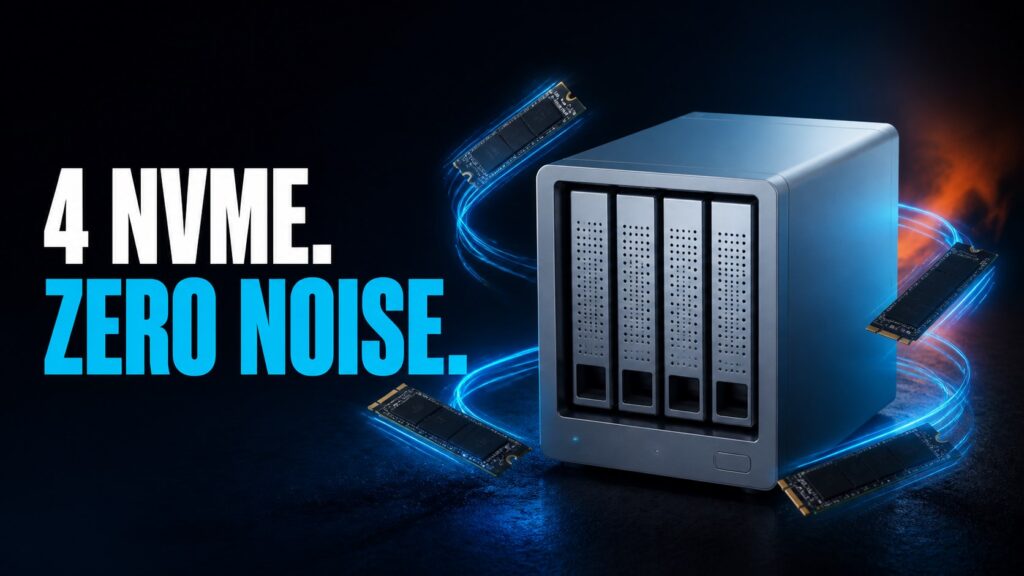
The TerraMaster F4 SSD is an all-flash NAS with four M.2 NVMe slots, an Intel N95, 8 GB of upgradeable DDR5, and TOS 7. It is compact and quiet, but its value depends on networking, cooling, and the total cost of SSDs.
Why an all-flash NAS matters
NVMe storage removes mechanical noise, lowers latency, and accelerates small files, thumbnails, databases, and containers. It also enables a compact enclosure and low idle power.
Not every task needs NVMe. A sequential copy over 2.5GbE tops out around 280 MB/s, far below one SSD. The benefit is concurrency, random access, and silence.
Hardware and expansion
The Intel N95 is an efficient x86 processor with media acceleration. The system ships with 8 GB of DDR5 and the current specification lists support for up to 32 GB. Four M.2 slots support TOS storage layouts such as TRAID or RAID where available.
Check the compatibility list, current capacity limits, and heatsink requirements. Avoid mixing SSDs with very different endurance in write-heavy arrays.
Thermals and sustained performance
NVMe drives can reach thermal limits during rebuilds, long copies, or indexing. Install pads and heatsinks as designed, keep vents clear, and monitor SMART temperature.
Short benchmarks can hide throttling. Copy a data set larger than cache and observe speed, temperature, and stability for several minutes.
TOS 7, containers, and media
The x86 platform supports Docker Manager and a broader app selection than ARM models. Use persistent volumes, Compose, and backups. Intel graphics can assist Plex, but licensing, drivers, formats, and subtitles still affect transcoding.
TOS 7 adds controls such as OTP and HyperLock on supported models. Continue to use MFA, VPN access, and external backups; silent storage is still vulnerable to mistakes and ransomware.
RAID and endurance
RAID 5 or TRAID balances capacity with one-SSD tolerance; RAID 6 reserves two drives for parity. Rebuilds write substantial data, so endurance and cooling matter.
Enable TRIM when supported, keep free space, and monitor TBW. RAID cannot prevent common firmware failures across identical SSDs or accidental deletion.
Total cost and alternatives
Add the NAS, four SSDs, a multigigabit switch, and client adapters. HDD NAS systems offer far more capacity per dollar for archives. The F4 SSD makes sense for active projects, photos, code, and quiet studios.
Compare it with an F4-424 Pro using SSD cache and with the D4 SSD DAS. A NAS shares data and runs services; a DAS attaches to one host and can expose more bandwidth.
Verdict
The F4 SSD does not replace every hard-drive NAS, but it offers an appealing mix of silence, low latency, and x86 services. It is most compelling when the workflow benefits from random access and multigigabit networking.