
This article may contain affiliate links. If you buy through these links, the price is the same for you and the store pays me a small commission that helps keep Tecnoyfoto running.

The Levoit Eleva 300X reacted to incense smoke, and the readings dropped again after I turned it back on. That was what surprised me most during the test in my son’s bedroom. However, watching a number change on a screen doesn’t answer every question: What does that number actually mean? How noisy is the purifier? What room size is it suitable for? And what about Home Assistant compatibility?
I’m Albert from Tecnoyfoto. This article complements my video with details about the testing method, its limitations, and the things worth checking before buying an air purifier. The room used for the test measures approximately 9–10 m² (97–108 sq ft). My conclusions describe that specific experience, not a laboratory test or a sleep study.
Collaboration disclosure: Levoit provided the air purifier for this review. The official store shopping link is an affiliate link: Tecnoyfoto may earn a commission if you purchase through it. The promotional code and links were supplied by the brand. My test observations are presented separately from the manufacturer’s advertised specifications.
Video: Putting the Levoit Eleva 300X to the Test
Levoit Eleva 300X: What Impressed Me and What I Would Check Before Buying
- What impressed me: the automatic response to rising particle levels, the changes shown in the graphs, and the power readings of approximately 24 W and 7 W observed at different points during the test.
- What I would check before buying: the actual room size, replacement filter costs, and specific compatibility with Home Assistant.
- What this test does not prove: a certified particle removal percentage, sensor accuracy, improved sleep quality, or a maximum-speed noise level of 20 dB.
How I Tested the Air Purifier with Incense Smoke
I placed the air purifier in the bedroom and used an Airzone device as an external reference. I also connected a smart plug with power monitoring and prepared a sound level meter. During the main part of the test, I kept the window and door closed.
I burned incense to introduce a source of airborne particles. The Levoit detected the change and increased its fan speed. I then turned it off for a few minutes. The displayed reading rose from around 160 to over 400. After removing the incense and restarting the purifier, the reading began dropping again.
I do not convert those numbers into micrograms per cubic meter or claim a specific cleaning percentage. The video shows different indicators and graphs. To compare them properly, we would need to identify the measured variable, its units, and the recording interval. A high number on one display does not automatically represent the same concentration on another device.
In the video, I mention approximately 11:13 as the time when I removed the pollution source and 11:40 as the time when the reading approached its initial level. That represents about 27 minutes of actual clock time. It does not mean that every edited segment is consecutive or that the room was completely free of pollutants afterward. The reading began improving earlier, but noticing an improvement within a few minutes and returning to the starting level are two different things.
My conclusion is more specific: in this particular room, I observed an automatic response and a clear decrease in the displayed reading after removing the pollution source and restarting the purifier. To determine how much of that decrease was directly caused by filtration, we would need repeated tests under equivalent conditions and a control test without the purifier, since airborne particles also settle and disperse naturally.
Incense was used for this specific test and should not be considered a recommended household routine. To improve indoor air quality, avoid deliberately introducing smoke, especially in spaces occupied by children or sensitive individuals. The EPA prioritizes controlling pollution sources and providing adequate ventilation, with air filtration serving as a complementary measure.
Technical Specifications: What Levoit Advertises
| Specification | Manufacturer’s Information |
|---|---|
| CADR | 273 m³/h (approximately 161 CFM) |
| Recommended coverage | Approximately 23 m² (248 sq ft) at 4.8 air changes per hour; approximately 113 m² (1,216 sq ft) at one air change per hour |
| Advertised noise level | 19–50 dB, depending on operating conditions |
| Rated power | 25 W |
The advertised coverage does not mean that the purifier can completely clean the air in any home within twelve minutes. Changing the number of air changes per hour significantly affects the claimed coverage area.
What Room Size Is the Levoit Eleva 300X Suitable For?
To get a rough idea, we can calculate equivalent air changes per hour ≈ CADR ÷ room volume. This is an approximate sizing calculation, not a guarantee of perfect air mixing or a measurement taken in the bedroom shown in the video.
For example, a room measuring 20 m² (215 sq ft) with a ceiling height of 2.5 m (8.2 ft) has a volume of 50 m³. With a CADR of 273 m³/h, the result would be approximately 5.46 equivalent air changes per hour at the rated airflow. At a lower nighttime fan speed, the available airflow will also be lower.
I would not simply add together the square footage of two separate bedrooms. Doors, hallways, and air circulation all matter. When choosing between this model and a larger purifier, I would start by measuring the room where the device will actually operate, deciding which fan speed is acceptable, and checking the total replacement filter cost. I have not performed a simultaneous comparison against the Core 300S or Vital 100S, so I cannot declare a winner between those models.
Noise Levels for Sleeping: An Important Clarification About the Video
In the video, I mention subtracting the background noise reading from the reading obtained while the purifier was running. That simple arithmetic subtraction does not give us the purifier’s actual sound level. Decibels use a logarithmic scale, as explained in OSHA’s technical documentation.
As a mathematical example, if we measured 60 dB of total sound and 40 dB of background noise under comparable conditions, logarithmic subtraction would give approximately 59.96 dB for the source, not 20 dB. This illustrates the calculation; it does not recalibrate the measurements shown in the video. Distance, frequency weighting, microphone position, and the sound of my own voice can all affect the result.
Therefore, the video allows viewers to hear how the fan noise changes, but it does not establish a certified sound level at maximum speed. To assess bedroom comfort, I would test the purifier from the pillow position, using the lighting settings intended for nighttime operation, over a normal night’s sleep. The quieter operating mode also moves less air. I have not measured any improvement in sleep quality, and I cannot promise that everyone will find the sound equally comfortable.
Power Consumption: What Would the Test Readings Cost?
The smart plug showed approximately 24 W during intensive operation and 7 W at a later point. These are individual readings, not an average measured over an entire night.
| Assumed Constant Power | Monthly Energy Use | Estimated Cost |
|---|---|---|
| 7 W | 1.68 kWh | €0.34 |
| 24 W | 5.76 kWh | €1.15 |
The formula is watts ÷ 1,000 × hours × days. Replace the example electricity rate with the actual variable energy cost from your utility bill and remember to include replacement filters. These figures do not represent a current electricity tariff or a prediction of actual consumption in automatic mode, where power usage changes throughout operation.
DuoShield Filters: What to Check and What a Clean-Looking Filter Really Means
Levoit uses the name DuoShield for its filtration system, which includes separately replaceable HEPA and activated carbon filters. Its official product introduction identifies AirSight Plus 2.0 as a sensor system monitoring PM1.0, PM2.5, and PM10, and advertises a main filter lifespan of up to two years under suitable conditions. These are manufacturer claims, not results verified by my test.
After completing the test, I opened the purifier and the filter still appeared clean. That does not mean it had failed to capture particles. A brief visual inspection cannot establish filter saturation or efficiency. The video also shows the carbon material inside the filter, which should not be confused with accumulated dirt.
During setup in VeSync, I encountered a QR code authentication step. My advice is to check the exact replacement filter model, keep its documentation, and follow the manufacturer’s maintenance instructions. The presence of this QR code alone does not prove that all third-party filters are blocked. Any categorical statement in the video about that issue should be understood with this limitation. Before purchasing, verify filter compatibility, availability, and pricing.
VeSync and Home Assistant: My Custom Adaptation Is Not Guaranteed Support
In the video, I install VeSync, add the purifier, update its firmware, and authenticate the filter. I then explain that I used a local software adaptation to display information in Home Assistant.
The official Home Assistant VeSync integration documentation requires users to register their devices in the VeSync app first. As of the date checked, it does not explicitly list the Eleva 300X, although it notes that its supported device list may be incomplete. The community support request is not confirmation of official compatibility either.
If Home Assistant compatibility is essential for you, check the regional model identifier, your integration version, and which entities are actually available. Seeing data through my custom adaptation does not guarantee full control, cloud-free local operation, or immediate compatibility with another installation. I also cannot promise when official support might become available.
To understand the difference between air filtration and ventilation, you can also read our Home Assistant ventilation assistant guide (in Spanish).
Does It Remove CO₂, Odors, or All Smoke Pollutants?
A particle reading is not a CO₂ measurement. I would not use the purifier’s colored indicator alone to decide whether a room needs fresh air. Likewise, a falling particle reading does not prove that all gases released by the incense have disappeared.
According to the EPA’s guide to air cleaners in the home, CADR describes particle removal. Removing gases requires appropriate filtration media, and no single air cleaner eliminates every pollutant. Removing airborne particles and addressing moisture, mold, or a pollution source are different tasks.
My Opinion of the Levoit Eleva 300X After Testing It
I would consider the Levoit Eleva 300X for someone looking for an automatic air purifier for a specific room who wants to monitor air quality trends without constantly adjusting fan speeds. During my bedroom test, its response and the subsequent decrease in readings impressed me. The observed power consumption also seems reasonable for extended use, provided that replacement filter costs are considered.
I would think more carefully before buying it if the priority were a large open-plan space, independently certified noise measurements from this particular test, guaranteed local smart home control, or a solution intended to replace proper ventilation. My recommendation depends on room size and whether those limitations are acceptable, not simply on an impressive number printed on the box.
Where to Buy: 20% Discount with the Tecnoyfoto Code at the Official Store
You can check the product at the following stores. The official store link is an Awin affiliate link: Tecnoyfoto may earn a commission on purchases made through it. This commission is separate from the discount offered by the promotional code.
- View the Levoit Eleva 300X on Amazon Spain.
- View the Levoit Eleva 300X at the official Spanish store (affiliate link). Promotional code: Tecnoyfoto. Advertised discount: 20%. Verify eligibility and discount conditions at checkout.
The 20% discount applies to Levoit’s official Spanish store. It has not been confirmed whether the code also works on Amazon. These links direct visitors to Spanish stores. Product availability, shipping options, promotions, and purchase conditions may differ in the United States and other countries.
Frequently Asked Questions
Does this test prove that the air purifier improves sleep?
No. The test examines the purifier’s response to airborne particles and demonstrates the sound of its fan. It is not a sleep study.
Can I directly compare the Airzone and Levoit readings?
Only if both readings represent the same variable, measurement units, and methodology. Their colors or numerical air quality indicators may use different scales. A faster response does not automatically mean greater accuracy.
Does the Tecnoyfoto discount code work on Amazon?
The advertised 20% discount is intended for Levoit’s official Spanish store. Its validity on Amazon has not been confirmed.
Where can I find the main sections of the video?
Unboxing: 02:08; filters: 03:27; VeSync: 08:05; incense smoke test: 15:31; filter inspection: 27:39; Home Assistant: 29:13. These timestamps refer to video playback, not elapsed time during the experiment. The original video is in Spanish.
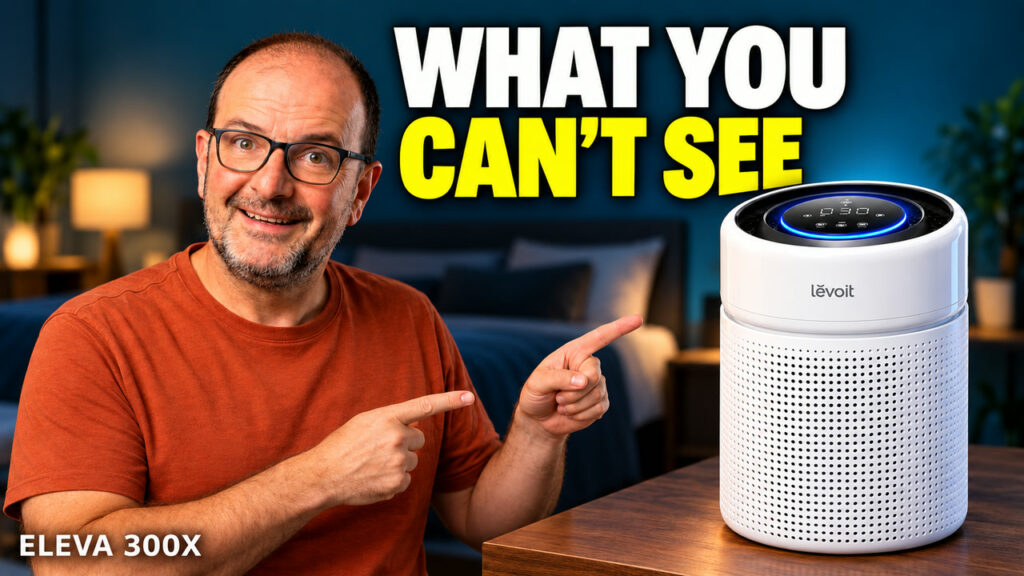
Companion article to the Tecnoyfoto video. Sources and compatibility information checked on October 17, 2026. Header and promotional images are editorial compositions created using references of Albert and the product; they are not actual frames from the test.
Continue reading
Next related guide · 4 min read
Tuya in Home Assistant: Smart Life and QR Code Setup
Updated August 27, 2026. Home Assistant’s official Tuya integration no longer requires the Tuya IoT developer-project workflow found in many older guides. The current…
Continue with this article