As an Amazon Associate, I earn from qualifying purchases. En calidad de Afiliado de Amazon, obtengo ingresos por las compras adscritas que cumplen los requisitos aplicables. If you buy through these links, the price is the same for you and Amazon pays me a small commission that helps keep Tecnoyfoto running.

Updated August 26, 2026.
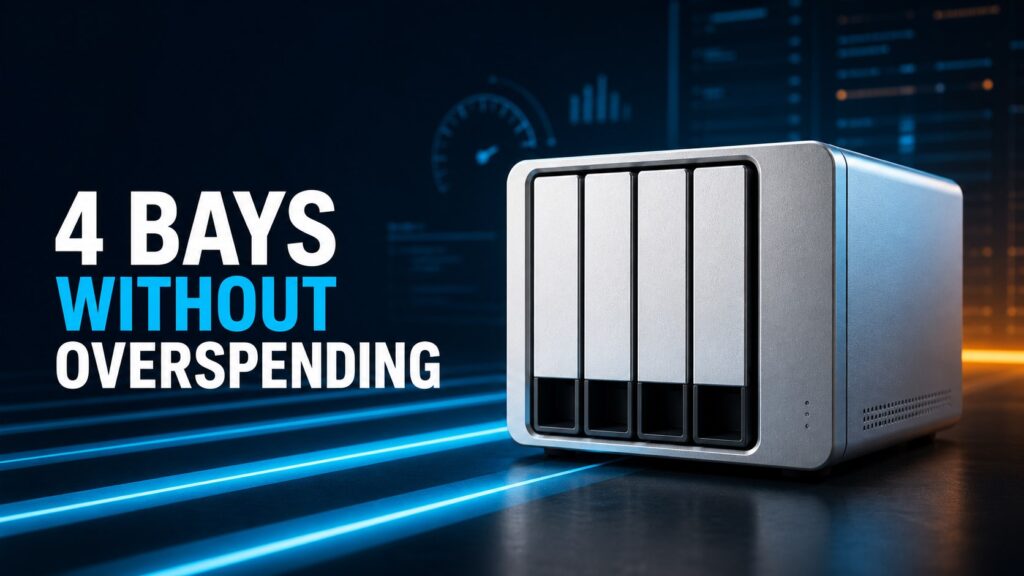
The TerraMaster F4-212Affiliate link brings the company’s entry-level ARM platform to four drive bays. Its appeal is affordable redundant capacity; its limits are Gigabit Ethernet, 2 GB of non-upgradable memory, and the TOS 7 ARM application catalog.
F4-212 versus F2-212
Both target home users and use a quad-core Realtek platform, but the F4-212 adds 2 GB of memory and four bays. That enables RAID 5 or TRAID with more usable capacity and one-drive fault tolerance, plus expansion within the selected storage rules.
It is not a discounted F4-424 Pro. There is no x86 CPU, NVMe storage, or 2.5GbE. Users who need containers, virtual machines, or direct video editing should move upmarket.
- F2-212: lower cost, two drives, RAID 1.
- F4-212: four drives and more flexible capacity.
- F4-424 Pro: x86 CPU, more memory, NVMe, and dual 2.5GbE.
Performance and drive selection
The 1GbE port limits a single client to a theoretical 125 MB/s. RAID 5 improves capacity and resilience but cannot make one workstation exceed the network link. Four disks can still help with concurrent clients and internal tasks.
Use compatible NAS drives and avoid mixing unknown drive technologies or histories. TRAID simplifies growth with different capacities; conventional RAID is more predictable for experienced administrators.
Four bays do not mean four backups. A RAID volume is still one logical copy.
TOS 7 ARM compatibility
TOS 7 ARM has supported the F4-212 since August 2026. Migrating from TOS 5.1.73 or later clears system settings, so inventory accounts, shares, permissions, networking, and jobs first.
The ARM edition omits Surveillance Manager, iSCSI Manager, Portainer, and other named applications. Check the model-specific App Center before buying for a particular workload.
- Verified external backup.
- Configuration notes or screenshots.
- Healthy SMART data and a non-degraded array.
- Enough downtime to rebuild services.
RAID, snapshots, and backup
With four equal drives, RAID 5 or TRAID balances usable capacity and one-drive protection. RAID 6 trades more capacity for two-drive tolerance; confirm availability and account for rebuild time. Btrfs snapshots are useful for accidental changes.
Add a USB copy and an off-site copy. Snapshots cannot help when the appliance is stolen, damaged, or the entire pool becomes inaccessible.
Media and applications
The processor can decode video, but client compatibility still determines the experience. Favor direct play and disable indexers or services you do not use. Two gigabytes provide more room than the F2-212 but remain modest.
For Home Assistant, databases, serious Docker use, or virtualization, choose a separate server or an x86 TerraMaster. The F4-212 is strongest when dedicated to storage and backup.
Security and maintenance
Enable MFA, updates, automatic blocking, and alerts. Never publish the TOS interface through a router port forward. Use a VPN for remote administration and unprivileged SMB accounts.
Monitor temperature, fan behavior, reallocated sectors, and free capacity. Test restores and document the drive-replacement procedure before a failure occurs.
Verdict
The F4-212 offers substantial home storage for the money, and TOS 7 extends its useful life. It is a good backup and direct-play media NAS, but not a multigigabit or x86 application server.