

Last updated on January 23, 2026
Let’s be clear: Ohm’s Law is the single most important principle in all of electricity and modern electronics. For students, it’s as foundational as E=mc² is to physicists. But for pros and DIYers like us, it’s our go-to diagnostic tool in the field. In this definitive 2026 guide, we’re breaking it down from the ground up, covering everything you need to know to apply it today.
What Is Ohm’s Law? The Formula That Rules Every Circuit
Ohm’s Law describes the mathematical relationship between the three fundamental quantities in an electrical circuit. Formulated by German physicist Georg Simon Ohm in 1827, his key discovery was that the current flowing through a conductor is directly proportional to the voltage applied across it and inversely proportional to the resistance.
The core Ohm’s Law formula is expressed as:
V = I x R
Where:
- V stands for Voltage.
- I stands for Current (from the French *intensité de courant*).
- R stands for Resistance.
The Core Four: Voltage, Current, Resistance & Power
To really master Ohm’s Law, you have to understand what each variable actually represents. I’ve put together an updated 2026 cheat sheet that summarizes these concepts, including Power, which we’ll get to in a minute.
| Quantity | Symbol | Unit (Abbr.) | Real-World Analogy | Role in a Circuit |
|---|---|---|---|---|
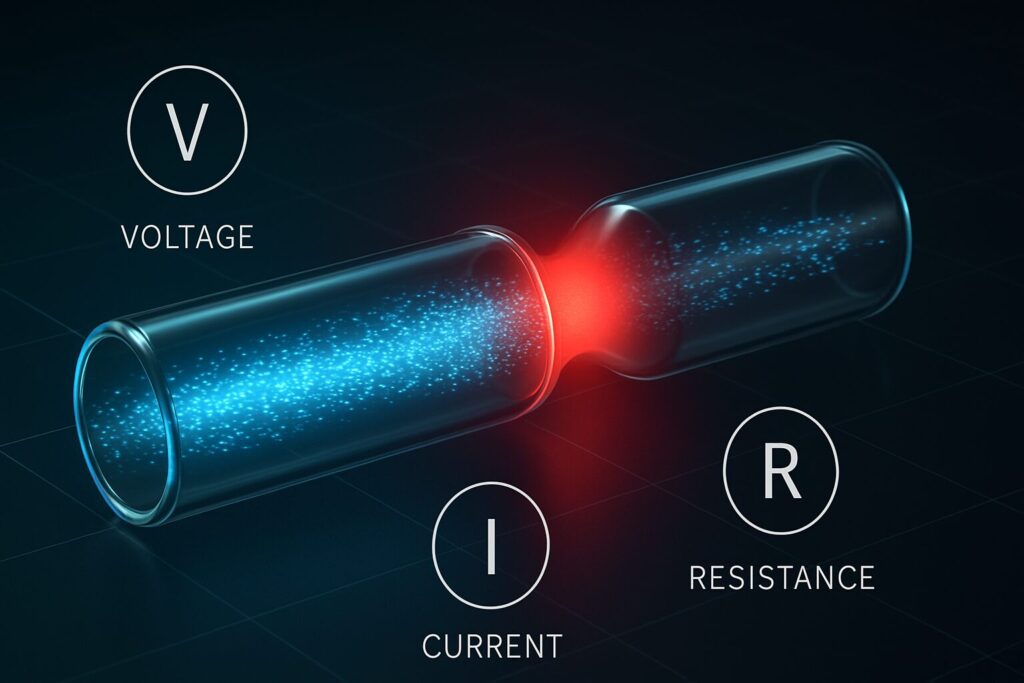
| Voltage | V (or E) | Volt (V) | The water pressure in a hose. | The “push” or potential difference that forces electrons to move. No voltage, no flow. |
| Current | I | Ampere (A) | The flow rate of water coming out of the hose. | The amount of electrical charge (electrons) passing a point in a circuit per second. |
| Resistance | R | Ohm (Ω) | A kink or narrow section in the hose. | The opposition to the flow of current. It limits how many electrons can get through. |
| Power | P | Watt (W) | The actual work the water does as it sprays out. | The rate at which electrical energy is consumed or converted per second. It’s the result of V, I, and R working together. |
The Ohm’s Law Triangle: Your Visual Cheat Sheet for Quick Calcs
One of the easiest ways to remember and apply the Ohm’s Law formula is with the famous “Ohm’s Law Triangle.” It’s a mnemonic device I personally recommend to everyone just starting out.

It’s incredibly simple to use: just cover the value you want to find, and the formula reveals itself:
- To find Voltage (V): Cover V. You’re left with I next to R. The formula is V = I x R.
- To find Current (I): Cover I. You’re left with V over R. The formula is I = V / R.
- To find Resistance (R): Cover R. You’re left with V over I. The formula is R = V / I.
A Critical Pro Tip: You can’t measure a component’s resistance with a multimeter while the circuit is powered on. Attempting to do so can fry your meter and will give you a completely bogus reading. This is why Ohm’s Law is indispensable: it allows us to safely calculate the resistance of a live circuit by measuring its voltage and current.
Let’s Get Practical: Ohm’s Law Examples in Action
Let’s run through a few common Ohm’s Law examples using a simple circuit to lock in these concepts.
Example 1: Calculating Current (I)
We have a 12V power supply connected to a 6Ω resistor. How much current is flowing?

I = V / R = 12V / 6Ω = 2A
Example 2: Calculating Resistance (R)
A circuit has a 24V source, and we measure a current of 6A. What’s the total resistance?

R = V / I = 24V / 6A = 4Ω
Example 3: Calculating Voltage (V)
If 5A of current is flowing through an 8Ω resistor, what’s the voltage drop across it?

V = I x R = 5A x 8Ω = 40V
Beyond the Triangle: The Ohm’s Law Power Wheel
The triangle is perfect for the basics, but in the real world, Power (P) is just as critical. Power, measured in Watts (W), tells us how much energy a device is actually using. Combining the power formulas with Ohm’s Law gives us the “Ohm’s Law Wheel”—a complete toolkit for any electrical calculation.
Here are the 12 essential formulas that every technician and DIYer should have in their back pocket:
| To Find Power (P) | P = V x I P = I² x R P = V² / R |
| To Find Current (I) | I = V / R I = P / V I = √(P / R) |
| To Find Voltage (V) | V = I x R V = P / I V = √(P x R) |
| To Find Resistance (R) | R = V / I R = V² / P R = P / I² |
Knowing these formulas allows you to, for example, calculate what size circuit breaker you need for a string of outlets by knowing the total power draw of the devices you plan to plug in.
Real-World Applications of Ohm’s Law in 2026
Far from being an ancient theory, Ohm’s law is more relevant than ever in 2026. I use it daily in situations like these:
- Smart Home & ESPHome/Arduino Projects: It’s essential for calculating the current-limiting resistor for an LED. If I have a board that outputs 3.3V and an LED rated for 2V at 20mA (0.02A), Ohm’s Law tells me exactly what resistor I need: R = (3.3V – 2V) / 0.02A = 65Ω. I’ll then choose the next standard value up (like 68Ω) to protect the LED.
- EV Charging Systems: Ohm’s law dictates the voltage drop across charging cables. A longer or thinner gauge wire has higher resistance, which causes a greater voltage drop and generates more heat, ultimately reducing charging efficiency.
- Electrical Troubleshooting: It’s my first line of defense. If a circuit trips a GFCI breaker, I’m checking insulation resistance. If an appliance is drawing too much power, I measure its voltage and current to calculate if its internal resistance has dropped (indicating a short) or if there’s a problem with the power source.
Important Limitations of Ohm’s Law You Should Know
While it’s universally useful, I have to point out that Ohm’s law isn’t a silver bullet. It has its limits and doesn’t apply perfectly in every scenario:
- Alternating Current (AC): In our homes, we use AC (typically 120V in the US). In AC circuits, besides simple resistance, we have inductive reactance (from motors and coils) and capacitive reactance. The combination of these forces is called Impedance (Z). The formula then becomes V = I x Z.
- Non-Ohmic Components: Ohm’s Law works perfectly for “ohmic” components like resistors, wires, and heating elements, which have a constant resistance. However, semiconductors like diodes, LEDs, and transistors are non-ohmic. Their voltage-current relationship is not a straight line.
- Temperature Effects: The resistance of most conductors increases as they heat up. For high-precision calculations or in environments with significant temperature swings, this factor must be taken into account.
Ohm’s Law FAQ (Frequently Asked Questions)
How is Ohm’s Law used in everyday life?
It helps you understand why a cheap, off-brand phone charger might damage your battery (if it delivers the wrong voltage or current), why you need a thicker gauge extension cord for a powerful tool, or why a 100W light bulb is brighter than a 60W one (it consumes more power).
What are the standard units for Ohm’s Law?
The standard SI units are: Volts (V) for voltage, Amperes (A) for current, and Ohms (Ω) for resistance. When we bring power into the equation, we use Watts (W).
The Classic Question: What’s More Dangerous, Voltage or Current?
This is the one everyone asks. The technically correct answer is that the current is what causes physiological damage (like stopping your heart or causing burns). However, you need sufficient voltage to overcome the human body’s resistance and allow that dangerous level of current to flow. So, the real danger is a source that can supply both high voltage and high current.
Why can’t I measure resistance on a powered-on circuit?
When your multimeter is in ohmmeter mode, it sends out a tiny, precise current from its own battery to measure how the component resists it. If the circuit you’re testing is already live, it has its own voltage. These two power sources will clash, resulting in a completely meaningless reading and, worse, potentially causing permanent damage to your meter’s sensitive internal components.