

Last updated on March 8, 2026
The Google Nest Mini is a true veteran in the smart speaker game. Launched years ago, it remains one of the most affordable and reliable gateways to the Google Assistant ecosystem here in 2026. While technology has marched on, its timeless design and excellent voice recognition keep it in the conversation. But is it still a worthy purchase? In this updated Google Nest Mini review, I’ll give you my honest take on whether it still has a place in the 2026 connected home.
If you’re looking for a dirt-cheap way to put a voice assistant in every room, control your smart home devices, or just listen to some background music while you cook, the Nest Mini is still a contender. Its core strength was never its sound, but rather the power of Google’s intelligence packed into an incredibly compact form factor.
Google Nest Mini in 2026: The Good and The Bad
After years on the market, its strengths and weaknesses are crystal clear. Here’s the breakdown:
| ✅ Pros | ❌ Cons |
| Unbeatable Price: Especially during frequent sales, it’s an impulse buy that’s hard to resist. | Underwhelming Audio Quality: Fine for voice and podcasts, but it’s a letdown for music lovers. |
| Superior Voice Recognition: Google’s mics and software are still top-tier, hearing you clearly from across the room. | No 3.5mm Audio Jack: A long-standing omission that prevents you from hooking it up to a better speaker system. |
| Seamless Google Ecosystem Integration: Works flawlessly with Chromecast, Android TV, and other Nest devices. | Dated Connectivity: Lacks native support for modern protocols like Thread, unlike newer competitors. |
| Discreet, Sustainable Design: Small, with a fabric cover made from recycled plastic that blends in anywhere. | Cloud-Dependent: Most of its core functions require an active internet connection to work. |
Design and Features: A Classic That Holds Up
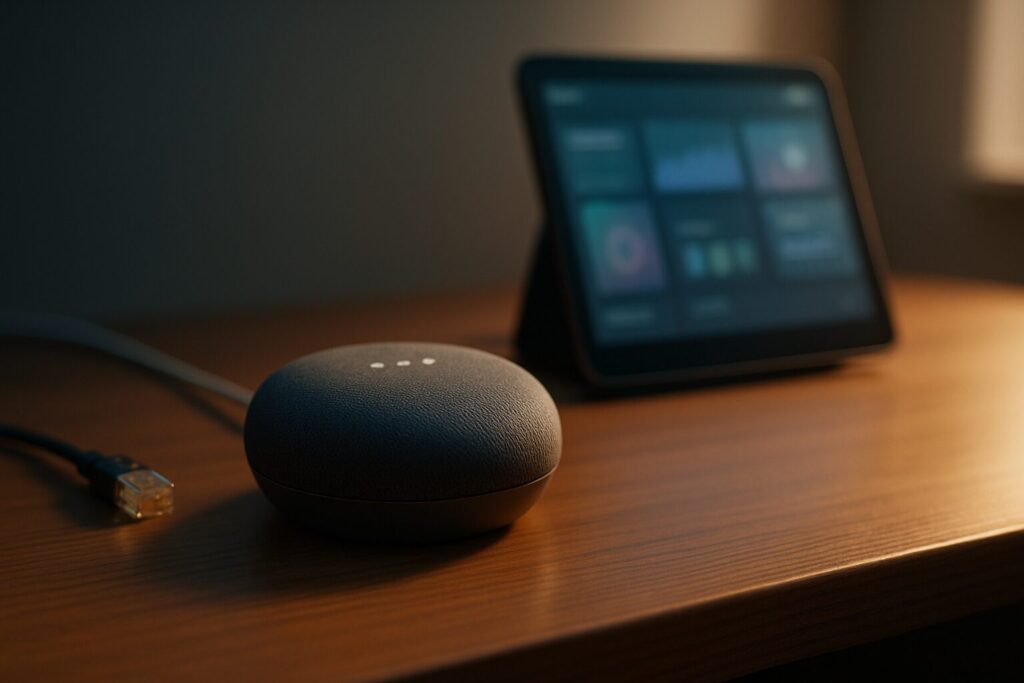
Aesthetically, the Nest Mini has aged surprisingly well. It’s a small, fabric-covered puck (now made from recycled plastic bottles) available in several muted colors. Physically, it’s nearly identical to its predecessor, the Home Mini, but the real upgrades are under the hood, with a faster processor and slightly improved sound.
It retains a handy physical switch on the side to mute the microphones—a crucial detail for privacy. The top LEDs light up to show when it’s listening, and two side LEDs indicate where to tap to adjust the volume. A useful addition was the keyhole mount on the base, allowing you to easily hang it on a wall, though you’ll still have to deal with the visible power cord.
Sound Quality & Performance: A Tale of Two Halves
Let’s be blunt: the Nest Mini’s sound quality isn’t its strong suit. Google boosted the bass compared to the original Home Mini, but in 2026, it just can’t keep up with similarly priced speakers. It’s perfectly fine for catching up on the news, listening to podcasts, or having some background tunes, but if you’re an audiophile, you’ll immediately notice the lack of depth and nuance.
Where it truly shines is in its ability to hear you. Its three far-field microphones and dedicated machine learning chip make voice recognition fast and accurate, even over background noise. Responses to common queries are nearly instantaneous, as they’re processed locally on the device.
Nest Mini vs. Echo Dot (2026 Models)
The classic showdown continues. The Nest Mini’s arch-rival has always been the Amazon Echo Dot. While we’re comparing it to the latest models, the core philosophies of each ecosystem remain the same.
| Feature | Google Nest Mini | Amazon Echo Dot (Latest Gen) |
|---|---|---|
| Voice Assistant | Google Assistant: Excels at contextual search and general knowledge queries. | Alexa: Broader ecosystem of ‘Skills’ and often wider third-party device compatibility. |
| Sound Quality | Clear for vocals, but weak bass. Acceptable for casual listening. | Generally superior for music, with a fuller, more bass-heavy sound. |
| Ecosystem | Best for heavy users of Android, Chromecast, Google Photos, and other Google services. | Perfect for Amazon Prime members, Fire TV users, Audible listeners, and Ring/Blink device owners. |
| Smart Home Connectivity | Wi-Fi & Bluetooth. Controls Google Home compatible devices. | Wi-Fi, Bluetooth, and, in recent models, acts as a Matter controller over Thread. |
| 3.5mm Audio Out | Nope. Never had it. | Removed in the latest generations. |
| Estimated Price | Usually around $49, with frequent sales dropping it below $30. | Similar price range, with very aggressive deals during events like Prime Day. |
Smart Home Integration: Real-World Use Cases
This is where the Nest Mini truly earns its keep as a voice control hub. It’s the simplest way to start building a smart home.
- Custom Routines: You can set up commands like “Hey Google, good morning” to have it turn on your smart lights, give you the weather forecast, read your day’s agenda, and play your morning podcast.
- Device Control: Direct commands like “Hey Google, set the living room light to 50%” or “Hey Google, close the bedroom blinds” become second nature.
- Media Ecosystem: If you have a Chromecast, you can say, “Hey Google, play the latest video from MKBHD on the TV,” and it’ll happen without you touching a remote.
- Power User Integration: For the more technically inclined, the Nest Mini integrates with platforms like Home Assistant. This allows you to control devices that aren’t natively supported, like those using Zigbee or Z-Wave, through external coordinators like the SMLIGHT SLZB-06 and Home Assistant add-ons.
Price and Competition in 2026
The Google Nest Mini’s price has remained stable, with an MSRP of $49, but it’s incredibly easy to find it on sale for $25-$30 throughout the year. At that price, it’s an absolute steal.
Its main competitor, as we’ve discussed, is the Amazon Echo Dot family, which often matches its sale prices. By 2026, we’ve also seen a rise in new entry-level speakers from other brands focusing on the Matter standard. These offer greater interoperability but often come at a slightly higher price and lack the deep ecosystem integration that Google and Amazon provide.
The Final Verdict: Who Should Buy the Google Nest Mini in 2026?
The Google Nest Mini has proven to be an incredibly resilient product. While it’s no longer on the cutting edge of technology, its value proposition remains rock-solid for specific types of users.
You should buy it if:
- You’re new to the world of voice assistants and want a cheap, easy-to-use starting point.
- You are already heavily invested in the Google ecosystem (Android, Chromecast, Google Calendar, etc.).
- You need a secondary speaker for a kitchen, bathroom, or bedroom where music quality isn’t the top priority.
- You value Google’s superior ability to answer complex questions and its excellent voice recognition above all else.
You should look elsewhere if:
- Audio quality for music is your number one priority.
- You need an audio-out jack to connect it to your existing sound system.
- You’re building an advanced smart home and want a hub with built-in local connectivity like Thread or Zigbee.
Bottom line: In my opinion, the Google Nest Mini in 2026 is like a trusty classic car. It may not have all the latest bells and whistles, but it does its core job exceptionally well and at a price that makes it almost impossible to ignore.