

Last updated on January 27, 2026
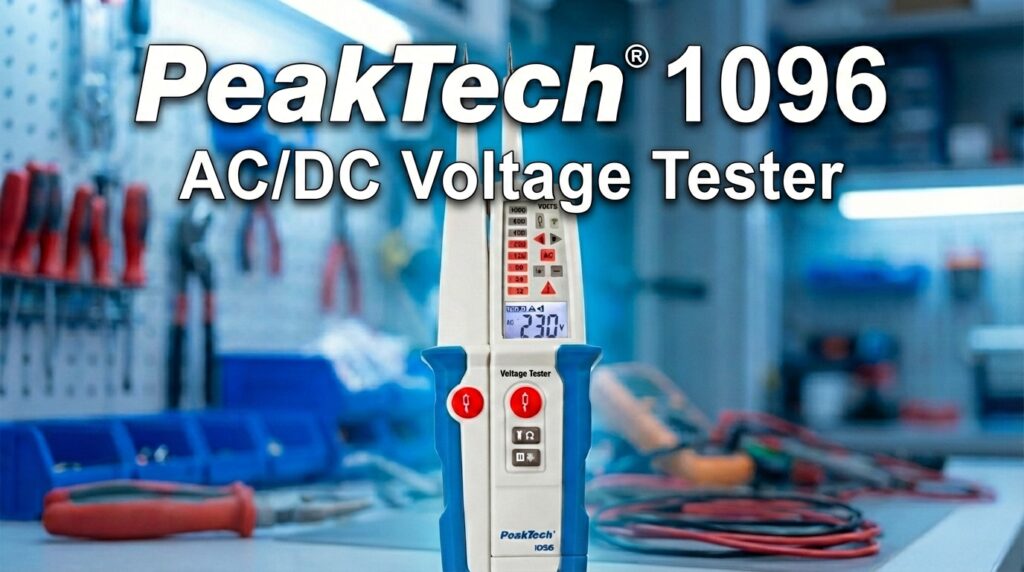
PeakTech 1096: In-Depth Review of 2026’s Ultimate Voltage Tester
As a professional electrician with over a decade in the field, I know the most important tool in your bag isn’t the most expensive one—it’s the one that saves your life. A reliable voltage tester is your first line of defense before you touch a single wire. Today, in 2026, we’re doing a deep dive on the PeakTech 1096, a device that’s been gaining traction for its solid balance of features, safety, and a wallet-friendly price tag. Is it really the best choice for pros and serious DIYers? Let’s find out.
This isn’t just a spec sheet rundown. This is a comprehensive, hands-on review from the field, designed to help you understand not just how to use this voltage tester, but why its safety rating is non-negotiable and how it compares to its main rivals in today’s market.
Core Features of the PeakTech 1096
The PeakTech 1096 is a two-pole voltage tester, sometimes called a “wiggy” by old-timers. Unlike a complex multimeter, its design is laser-focused on speed and safety for the most common daily tasks. Here are its key functions:
- AC/DC Voltage Measurement: Detects and displays voltage from 12V up to 690V using a clear, easy-to-read LED scale. It automatically identifies whether the current is alternating (AC) or direct (DC).
- Continuity Test: Lets you check if a circuit is complete (e.g., a fuse isn’t blown or a wire isn’t broken). It gives both an audible beep and a visual light—essential for noisy job sites.
- Polarity Indication: For DC circuits, it clearly shows which probe is on the positive terminal and which is on the negative.
- Single-Pole Phase Test: Allows you to quickly identify the hot wire with just one probe, acting like a traditional non-contact tester but with more certainty.
- Phase Rotation Indicator: A critical feature for professionals working with three-phase systems, like installing motors, to ensure the direction of rotation is correct.
- Integrated LED Flashlight: A small detail you’ll be incredibly thankful for when you’re hunched over a dark breaker panel or working in poorly lit areas.
- IP64 Protection: It’s rated for dust and water splash resistance, ensuring it can survive the rigors of a real-world construction site.
Field Test: PeakTech 1096 Pros and Cons
After weeks of using this tester on various jobs, from residential rewires to commercial installations, I’ve compiled the key advantages and disadvantages of this tool.
The Good Stuff (Pros)
- Certified Safety: Its compliance with the CAT III 600V electrical safety standard means it’s rated for working directly in distribution panels with total confidence.
- Incredible Value: It offers professional-grade features (like the phase rotation indicator) at a price that usually hovers around $45-$65, something unheard of just a few years ago.
- Rugged and Ergonomic: It feels solid in your hand. The rubberized coating provides a great grip and protects against minor drops.
- Point-and-Shoot Simplicity: The LED indicators are intuitive. There are no complex ranges to set; it’s a grab-and-go tool.
- All-in-One Convenience: For quick diagnostics, it replaces a non-contact voltage pen, a continuity tester, and a basic voltmeter, lightening your tool bag.
The Downsides (Cons)
- Doesn’t Measure Current (Amps): This is a tester, not a clamp meter or a full-featured multimeter. It can’t be used to measure power consumption.
- Limited Precision: It shows you voltage ranges (e.g., 240V), not the exact value (e.g., 238.5V). For precision measurements, you’ll still need a True RMS multimeter.
- Fixed Probes: While durable, the probes are not interchangeable. If you damage one, repairing it is not a practical option.
Electrical Safety: What Does CAT III 600V Actually Mean?
This is, without a doubt, the most important feature and one you should never ignore. Safety ratings (CAT ratings) define where you can safely use a measuring instrument. Getting this wrong can lead to an arc flash and serious injury.
- CAT I: Protected electronic circuits.
- CAT II: Single-phase loads connected to standard outlets (appliances, power tools).
- CAT III: Three-phase or single-phase fixed installations, like distribution panels, GFCI/RCD breakers, or circuit breakers.
- CAT IV: The origin of the installation (service drop from the pole, utility meters).
The PeakTech 1096, being CAT III 600V, is engineered to withstand the voltage transients (unexpected spikes of thousands of volts lasting microseconds) that can occur in an electrical panel. Using a lower-rated tester in this environment is an unacceptable risk. The “600V” value indicates the maximum nominal voltage of the installation where it can be safely used.
Real-World Use Cases: From Your Garage to the Job Site
Here’s where the PeakTech 1096 truly shines in day-to-day work.
Imagine a gallery of images or a short video showing these uses here.
Home & DIY Use
- Swapping a Receptacle: Before you touch a single screw, you verify with the PeakTech 1096 that the circuit is dead. It’s the final, crucial check after flipping the breaker.
- Installing a Light Fixture: Easily identify the hot wire to connect to the switch, ensuring it’s wired correctly and safely.
- Checking Fuses: With the power OFF, use the continuity test to see if a fuse is blown in seconds.
Professional Use
- Panel Diagnostics: Quickly verify the presence of voltage across all three phases at the output of a main disconnect.
- Motor Commissioning: Use the phase rotation indicator to ensure a three-phase motor will spin in the correct direction, preventing costly mechanical damage.
- Machinery Maintenance: Rapidly and safely check for voltage on contactors or test the continuity of motor windings.
PeakTech 1096 Alternatives in 2026
The PeakTech 1096 is a fantastic option, but it’s not alone. To give you a complete picture, I’ve put together this comparison chart with two of the most respected alternatives to the PeakTech 1096 on the market. The right choice for you will depend on your budget and the demands of your work.
| Model | Safety Category | AC Voltage Range | Standout Features | Estimated Price (2026) |
| PeakTech 1096 | CAT III 600V | 12V – 690V | Phase Rotation, Flashlight, IP64 | $45 – $65 |
| Fluke T130 | CAT III 600V / CAT IV 600V | 6V – 690V | Backlit LCD, Resistance, Vibration | $130 – $165 |
| Klein Tools ET45 | CAT III 600V | 24V – 240V AC / 1.5V – 24V DC | GFCI receptacle testing, Integrated probe holders | $55 – $85 |
The Verdict: My Final Take on the PeakTech 1096
After putting it through its paces, the general consensus on the PeakTech 1096 is overwhelmingly positive, and my experience confirms it. This is a tool that delivers exactly what it promises with excellent reliability and safety for its price point. It doesn’t try to be a multimeter, and that’s its greatest strength. It’s fast, tough, and safe.
Bottom Line: The PeakTech 1096 is the ideal purchase for the serious DIYer who prioritizes safety, for trade school students, and as a quick-grab diagnostic tool for the professional electrician. For anyone looking for the best voltage testers in 2026 without breaking the bank, this is one of the smartest buys on the market.
Frequently Asked Questions (FAQ)
How do you use the PeakTech 1096 to measure voltage?
It’s dead simple. Make sure the device has batteries and is functioning. Without pressing any buttons, just touch the black probe (COM) to the neutral or ground wire and the red probe to the suspected hot wire. The LEDs will light up to indicate the detected voltage level and whether it’s AC or DC.
What kind of batteries does it use?
The PeakTech 1096 runs on two 1.5V AAA batteries. They are cheap and easy to find, which is a plus for a tool you’ll use constantly.
Is it accurate enough for professional work?
It’s accurate for its intended purpose: verifying the presence and level of voltage. It will tell you if you have 120V, 240V, or 480V, but not if the precise reading is 118V or 121V. For most verification and safety tasks, its accuracy is more than sufficient. For calibration or sensitive electronics diagnostics, you’ll need a higher-end multimeter.
Can I test continuity with the power on?
ABSOLUTELY NOT. NEVER. Attempting to measure continuity on a live circuit is extremely dangerous and will likely destroy the tester, create a short circuit, and cause serious injury to you. The continuity test must always be performed on a de-energized circuit after you have killed the power at the main panel and verified there is no voltage present.
Continue reading
Next related guide · 8 min read
UNI-T UT18C In-Depth Review: Still the King of Budget Voltage Testers in 2026?
Last updated on February 10, 2026 ⚠️ SAFETY WARNING: Working with electricity poses serious risks. Always shut off the power at the main breaker…
Continue with this article