
As an Amazon Associate, I earn from qualifying purchases. En calidad de Afiliado de Amazon, obtengo ingresos por las compras adscritas que cumplen los requisitos aplicables. If you buy through these links, the price is the same for you and Amazon pays me a small commission that helps keep Tecnoyfoto running.

Last updated on February 10, 2026
UNI-T UT18C Review: The Ultimate Job Site Voltage Tester for 2026?
In an electrician’s day-to-day, the most-used tool isn’t always the most complex. Often, what you need is a fast, reliable, and rugged device for one critical task: verifying the presence or absence of voltage. This is where the **UNI-T UT18C voltage tester** comes in—a tool that, despite being on the market for years, remains a staple on job sites and in maintenance shops for its incredible price-to-performance ratio.
This isn’t just another product spec sheet. This is a deep-dive **UNI-T UT18C review** from the perspective of a pro who’s put it through its paces in the field. We’ll break down its features, stack it up against its main rivals, and I’ll tell you, straight up, if it’s still worth your money in 2026.
Key Technical Specs of the UNI-T UT18C
Before we get into the nitty-gritty, you need to know what it can do. I’ve corrected some of the inaccurate data floating around on product listings to give you a realistic picture of what you’re holding in your hand.
| Function | Specification |
| Voltage Ranges (AC/DC) | 12V, 24V, 50V, 120V, 230V, 400V, 690V (LED Indication) |
| Precise Voltage Reading | LCD Screen from 6V to 690V (1V Resolution) |
| Continuity Test | 0 to 100 kΩ (Audible beep and LED light) |
| GFCI / RCD Test | Yes, for 230V systems (phase-to-ground) |
| Phase Rotation Test | 100V ~ 690V, 50Hz ~ 60Hz |
| Polarity Detection | Automatic (Positive/Negative) |
| Safety Rating | CAT IV 600V, CAT III 690V |
| Ingress Protection | IP65 (Dust tight and protected from water jets) |
| Power Supply | 2 x 1.5V AAA Batteries |
| Extra Features | Built-in LED Flashlight, Data Hold, Self-Test |
UNI-T UT18C: The Pros and Cons
No tool is perfect. After years of using this tester, I’ve got a clear picture of its strengths and weaknesses.
| PROS (What I Love) |
|---|
| ✅ Built Like a Tank: Its rubberized housing and IP65 rating make it resistant to drops, dust, and water. This is a tool you can toss in your bag without worry. |
| ✅ Dual Indication (LED & LCD): Absolutely critical. The LEDs give you an instant voltage range, while the LCD provides the precise value. In noisy or poorly lit environments, this is a lifesaver. |
| ✅ Pro-Level Features: The phase rotation test and GFCI/RCD test are features you won’t find on basic testers, saving you from carrying extra tools. |
| ✅ Certified Safety: With a CAT IV 600V rating, you can confidently work on everything from the service entrance to final branch circuits. Safety is non-negotiable. |
| ✅ Unbeatable Bang for Your Buck: Considering the **price of the UNI-T UT18C**, which usually sits in the $50-$65 range, the features it offers are tough to beat. |
| CONS (What Could Be Better) |
|---|
| ❌ Not True RMS: This is its biggest drawback. Measurements on circuits with non-linear loads (VFDs, switching power supplies, cheap LED lighting) can be inaccurate. I explain in detail what True RMS is and why it matters here. |
| ❌ Test Probes Could Be Tougher: While the body is rugged, I’ve seen a few units with broken metal tips after heavy use. I recommend treating them with a bit of care. |
| ❌ Basic GFCI Test: The GFCI test function is a simple go/no-go. It will trip the breaker, but it doesn’t measure trip time or leakage current, which are necessary for official certification or detailed diagnostics. To learn more, check out my guide on GFCI and RCD types. |
| ❌ No Current Measurement: This is a voltage and continuity tester, not a full multimeter. It does not measure amps. |
Who Is This Voltage Tester Actually For?
Professional & Residential Electricians
It’s the perfect daily workhorse. Ideal for lock-out/tag-out procedures (verifying zero energy), quick checks in panels, identifying circuits, and commissioning new installs. Its rugged build and speed make it an essential tool for your belt. It won’t replace a clamp meter or an advanced multimeter for diagnostics, but for 90% of daily tasks, it’s more than enough.
Maintenance Techs (Industrial, HVAC)
Highly recommended. The wide voltage range (up to 690V) and phase rotation test are extremely useful for working with 3-phase machinery and motors. The dust and water resistance (IP65) is a major plus in harsh industrial environments.
Serious DIYers & Homeowners
If you take safety seriously when working in your home’s breaker panel, this is an excellent investment. It gives you a level of confidence that cheap non-contact pens can’t provide. It lets you properly verify that power is off, check the continuity of a wire, or ensure a GFCI outlet is working before calling a pro.
How to Use the UNI-T UT18C’s Key Features (Quick Guide)
Learning **how to use the UT18C** is intuitive, but here’s a breakdown of its most important functions to get you up and running on day one.
1. Verifying Voltage & Continuity
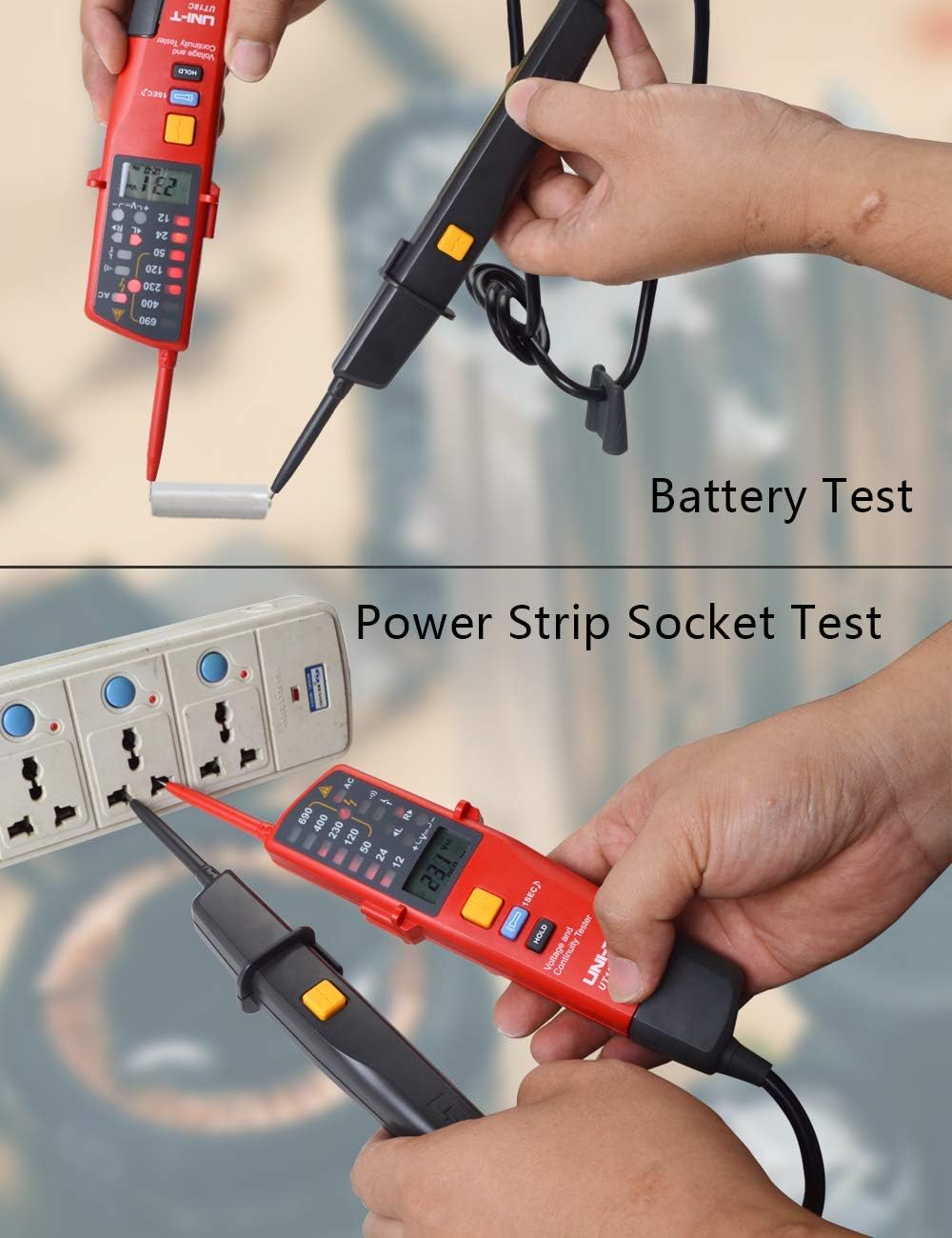
This is its core function. Simply touch the probes to the terminals or wires you need to measure. The unit turns on automatically, detects AC or DC, and shows you the value on both the LED range indicators and the LCD screen. For continuity, ensure the circuit is **completely de-energized**, touch the probes together on either end of the wire, and if the path is complete, the tester will beep and light up the continuity LED (Ω).
2. Testing GFCI / RCD Outlets
This is a fundamental safety check.
- At the electrical panel or outlet, ensure you’re testing a circuit in the 120V-230V AC range.
- Place the “L” probe (from the main body) into the Hot terminal.
- Place the external “N” probe into the Ground terminal (PE), NEVER the Neutral.
- Press both “RCD” buttons on the meter’s body simultaneously.
If the GFCI (or RCD) breaker is working correctly, it will trip, cutting off the power. This simulates a ground fault, confirming the protection mechanism is operational. Note: This feature is designed for higher-current European RCDs. While it often works on US GFCIs, a dedicated plug-in GFCI tester is recommended for official checks, as they trip at a much lower current (~5mA).
3. Detecting Phase Sequence
Essential for 3-phase installations, like checking the rotation direction for a motor.
- Place the L probe on one phase (e.g., L1) and the N probe on another (e.g., L2).
- The tester will display a rotation symbol (spinning arrows).
- Keep the L probe on L1 and move the N probe to the third phase (L3).
- The rotation symbol should remain the same. If it reverses, your phases are swapped.
UNI-T UT18C vs. Popular Alternatives in 2026
The voltage tester market is crowded. Here’s how the UT18C stacks up against two well-known competitors.
| Feature | UNI-T UT18C | Fluke T5-600 | Beha-Amprobe 2100-Alpha |
|---|---|---|---|
| Voltage Range | 6-690V AC/DC | Up to 600V AC/DC | Up to 690V AC/DC |
| Current Measurement | No | Yes, up to 100A (OpenJaw) | No |
| True RMS | No | Yes (AC) | Yes |
| GFCI/RCD Test | Yes | No | Yes |
| Safety Category | CAT IV 600V | CAT III 600V | CAT IV 600V |
| Estimated Price | $50 – $65 | $160 – $195 | $100 – $130 |
The Bottom Line: Final Verdict from a Pro
In 2026, the **UNI-T UT18C voltage tester** remains one of the best value-for-money tools on the market for any electrical professional. Its ruggedness, measurement range, and extra features like the GFCI test and phase sequence put it head and shoulders above basic testers.
Is it perfect? No. The lack of True RMS is a deal-breaker for precision diagnostics on power electronics or systems with heavy harmonics. However, for general installation, verification, and maintenance work, its strengths far outweigh its flaws.
My recommendation is clear: if you’re looking for your first serious measurement tool, or a dependable “beater” two-pole tester for daily work that you won’t cry over if it gets banged up, the UT18C is a smart and safe buy.
Frequently Asked Questions (FAQ) about the UNI-T UT18C
Does the UNI-T UT18C measure amps?
No, this device is an **AC/DC voltage and continuity tester**. It does not have the capability to measure current (amperage). For that, you would need a clamp meter or a multimeter with that specific function.
Does it need batteries or is it line-powered?
It runs on two 1.5V AAA batteries. However, a key safety feature is that even with dead or no batteries, it can still perform basic voltage detection above 50V, though the LCD screen and other features will not work. This passive safety function is a great touch.
Should I get this or a full CAT IV 600V multimeter?
It depends on your job. For quickly and safely verifying voltage, the UT18C is faster and more rugged. A full **CAT IV 600V multimeter** is a diagnostic tool, perfect for measuring resistance, capacitance, frequency, and for deeper analysis. In my opinion, they are complementary tools in a professional’s toolbox.
Is the built-in flashlight actually useful?
Yes, it’s a very handy support light for illuminating dark areas inside an electrical panel or junction box while you’re taking measurements. It won’t replace a headlamp, but it gets the job done perfectly.
Continue reading

Next related guide · 7 min read
PeakTech 1096 In-Depth Review: The Pro Electrician’s Go-To Voltage Tester for 2026?
Last updated on January 27, 2026 ⚠️ SAFETY WARNING: Working with electricity can be deadly. Always kill the power at the main breaker before…
Continue with this article