
As an Amazon Associate, I earn from qualifying purchases. En calidad de Afiliado de Amazon, obtengo ingresos por las compras adscritas que cumplen los requisitos aplicables. If you buy through these links, the price is the same for you and Amazon pays me a small commission that helps keep Tecnoyfoto running.

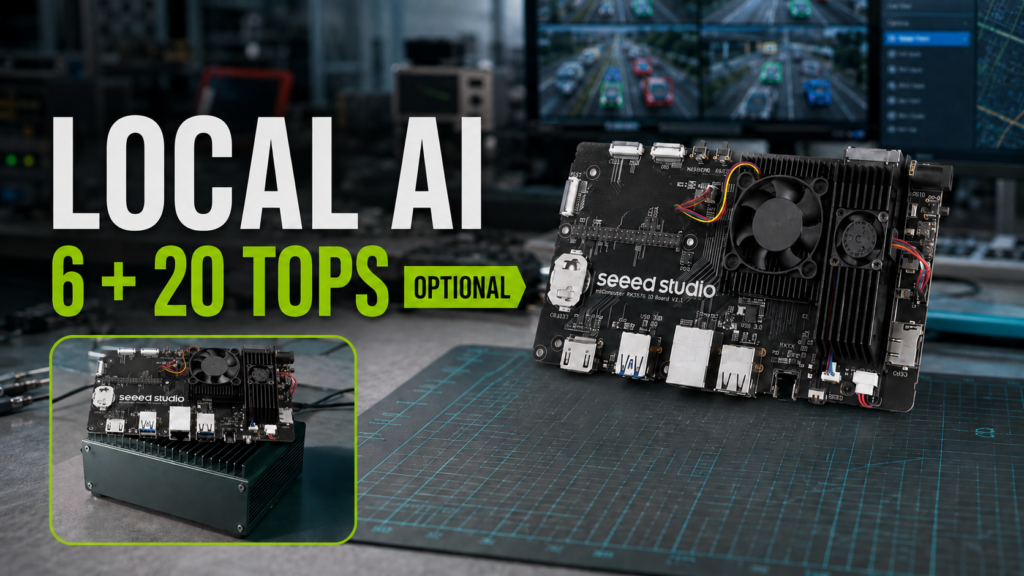
Seeed Studio is expanding its edge artificial intelligence catalog with a family aimed at people who want to build their own systems: reComputer RK3576. It starts with a compact Rockchip RK3576 compute module and a built-in 6 TOPS NPU, then scales through an I/O board, a complete development kit, and an optional 20 TOPS RK1820 accelerator.
The headline figure is 26 TOPS, but it needs an immediate qualification: the RK3576 itself delivers 6 TOPS. The additional 20 TOPS come from the RK1820 accelerator included only with the top configuration. Not every module or development kit in this family delivers 26 TOPS.
What is reComputer RK3576?
reComputer RK3576 is a modular platform rather than a single board. Seeed sells the compute module, a carrier board, a complete development kit, and a version of that kit with extra AI acceleration. A team can therefore begin on ready-to-use development hardware and later design a custom carrier around the same module.
At its core is Rockchip’s RK3576, an eight-core SoC combining four Cortex-A72 and four Cortex-A53 CPU cores, a Mali-G52 MC3 GPU, and a 6 TOPS INT8 NPU. The module is approximately 55 × 40 mm, connects through a 200-pin board-to-board interface, and supports LPDDR5 memory and eMMC storage configurations. Seeed currently lists 4 GB + 32 GB and 8 GB + 64 GB modules while documenting platform options up to 16 GB of RAM and 128 GB of eMMC.
Module, I/O board, and kits compared
| Product | What is included | Advertised AI performance | Official price* |
|---|---|---|---|
| RK3576 module 4 GB/32 GB | Compute module | 6 TOPS | US$130 |
| RK3576 module 8 GB/64 GB | Compute module | 6 TOPS | US$170 |
| Module I/O Board | Carrier board, no module | No NPU of its own | US$18 |
| Dev Kit | Module, I/O board, and cooling | 6 TOPS | US$219 |
| Dev Kit + RK1820 | Kit and additional accelerator | 6 + 20 TOPS | US$379 |
The compute module is intended for integrators and product designers. Its small dimensions are useful, but it needs a compatible carrier to supply power and expose interfaces. It is not a standalone single-board computer that you simply place on a desk.
The I/O board exposes the module’s connectivity, including Gigabit Ethernet with PoE PD input, M.2 M-Key, HDMI, USB-C DisplayPort, USB, MIPI CSI/DSI, and GPIO. It is a prototyping and validation carrier; it does not contain an RK3576 processor by itself.
The standard Dev Kit combines the module, carrier, and cooling needed to begin development. It is the practical choice for evaluating computer vision, embedded Linux, or a future custom board without designing hardware first.
The RK1820 version adds a 20 TOPS accelerator with 2.5 GB of integrated DRAM. Seeed positions this heterogeneous setup for multiple AI workloads, vision models, and multimodal agents. This is the configuration that adds up to the advertised 26 TOPS; the standard kit remains a 6 TOPS platform.
What edge AI actually means
Edge AI processes information close to where it is captured. A camera can analyze frames without continuously uploading video to a remote server. Industrial equipment can detect an anomaly even when Internet access is unavailable, while an offline voice system can recognize commands without sending every recording to the cloud.
That does not make reComputer a universal replacement for a desktop PC with a powerful GPU. Its value comes from compact dimensions, restrained power requirements, physical interfaces, and specialized acceleration. It fits the same local-first thinking explored in our guide to AI for the smart home.
Real workloads for the 6 TOPS NPU
- Computer vision: object detection, classification, segmentation, OCR, and visual inspection.
- Camera analytics: filtering events locally, counting people or vehicles, and reducing video traffic.
- Offline speech: wake words, speech-to-text, and text-to-speech with hardware-appropriate models.
- Robotics: combining cameras, GPIO, and local decisions with predictable latency.
- Industrial control: defect detection and monitoring where connectivity is limited or expensive.
- Compact LLMs and VLMs: local assistants, retrieval, and multimodal analysis using quantized models that fit the available memory.
Seeed already provides an official YOLOv11 object-detection example for RK3576 using RKNN-Toolkit2 and Docker. That matters because a useful edge platform needs more than a specifications page: it needs a repeatable software path. If your project starts with IP cameras, our guide to finding an RTSP stream URL explains how to obtain the video feed that the device will analyze.
When does the RK1820 make sense?
The optional accelerator is not an automatic speed boost for every application. It is useful when compatible models and tooling exist, when the built-in 6 TOPS NPU cannot meet the target, or when workloads should be separated. A system might keep real-time vision on one engine while language or multimodal processing runs on the other.
It also adds US$160 to the kit at the prices checked for this article. Before purchasing it, define the model, verify the conversion path, and confirm which operators the runtime supports. The RK1820’s 2.5 GB of integrated DRAM supports the accelerator, but it does not replace system RAM or guarantee that an arbitrary large language model will run well.
Why TOPS is not a universal speed rating
TOPS means trillions of operations per second, but the number depends on numerical precision, architecture, and each vendor’s stated conditions. Two accelerators with the same TOPS rating can produce very different results with a particular model.
It would therefore be misleading to claim that 26 TOPS is always 4.3 times faster than 6 TOPS. The sum describes the theoretical capacity of two separate engines. Real performance depends on model compatibility, quantization, memory bandwidth, workload distribution, and software. TOPS is a useful capacity indicator, not a complete benchmark.
Connectivity built for prototypes
The carrier board keeps the module from becoming a closed demonstration. M.2 supports storage or acceleration options, Gigabit Ethernet moves results across a network, and PoE PD input can simplify deployment where compatible infrastructure already exists. HDMI and USB-C DP support local development, while MIPI CSI/DSI and GPIO accommodate cameras, displays, and custom electronics.
The RK3576’s multimedia hardware is relevant too. Rockchip documents high-frame-rate 4K decoding for several codecs, 4K encoding, and a 16-megapixel ISP; Seeed also highlights 8K decoding for its module. Those capabilities are valuable in vision systems, although video resolution and inference speed remain separate considerations.
reComputer AI Lab and the software question
Hardware matters only when developers can deploy models without rebuilding the entire software stack. Seeed pairs the family with reComputer AI Lab, its development platform for reComputer edge devices. The company presents it as a short deployment path for computer vision, speech, LLM, and VLM applications.
Production projects will still need to validate versions, dependencies, thermals, power, and maintenance. Even so, system images, Docker examples, and RKNN projects reduce early friction compared with unsupported hardware. Readers who want to build the underlying knowledge first can use our list of free artificial intelligence courses.
Who should consider it?
The standard Dev Kit is compelling for embedded Linux, computer vision, robotics, and IoT developers who need extensive interfaces and want to evaluate Rockchip before designing a carrier. The module is aimed at integrators moving toward a custom product. The RK1820 bundle targets heavier or simultaneous workloads.
It is not the easiest answer for someone who only wants a desktop application, and buying it does not guarantee instant support for every model found online. It is not a drop-in Raspberry PiAffiliate link replacement either: the modular idea is familiar, but the priorities are AI and product development. For small sensors and straightforward automation, an ESP32 will often remain simpler and less expensive.
Verdict
Seeed Studio has assembled a coherent family: a compact module, an inexpensive carrier, a ready-to-develop kit, and optional acceleration. The 6 TOPS reComputer RK3576 is the foundation; the RK1820 raises the advertised combined ceiling to 26 TOPS for compatible projects that genuinely need it.
The promising part is not one headline number but the ability to choose how much hardware to buy while retaining a route toward more demanding prototypes. Real models, long-term software support, and independent measurements will decide its lasting value, but reComputer RK3576 is a platform worth watching for local AI, vision, and robotics.