
Updated on January 25, 2026
If you’ve been anywhere near the smart home space in the last few years, you’ve heard the buzzword that changed everything: Matter. But what is Matter, exactly? And why, here in 2026, has it become the undisputed foundation of the connected home? Forget compatibility headaches and convoluted setups. Matter is the unified, ‘it just works’ answer we’ve all been waiting for.
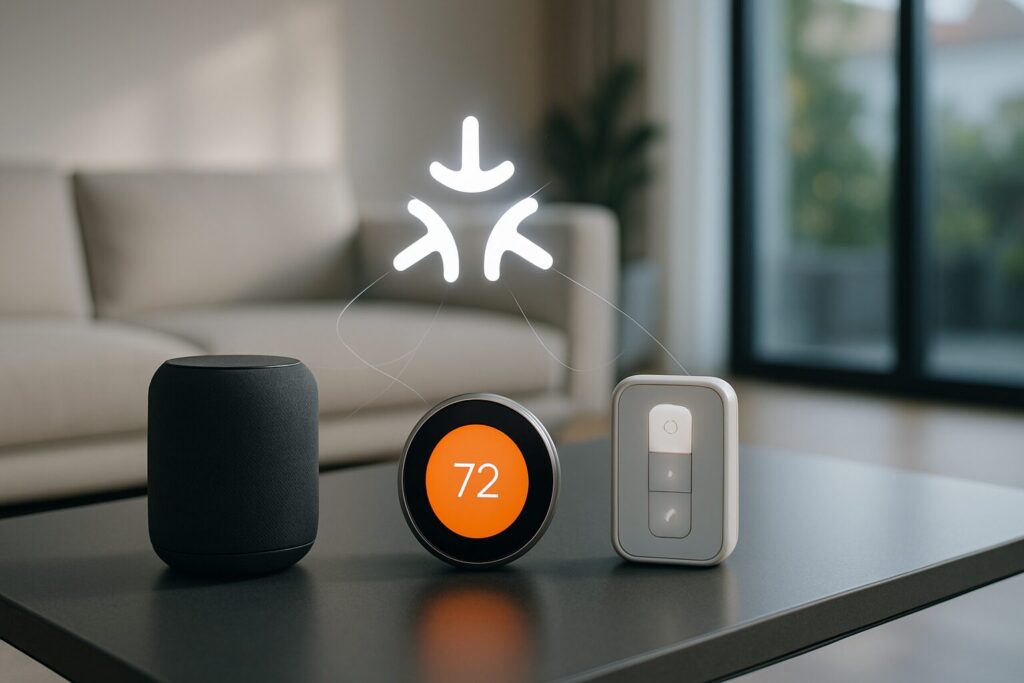
In a nutshell, Matter is an open-source connectivity standard developed by the Connectivity Standards Alliance (CSA), which includes tech titans like Apple, Amazon, Google, and hundreds of other manufacturers. Its goal is simple yet revolutionary: to make every smart home device certified with its logo work seamlessly with any other, regardless of the brand. Think of it as the universal language for the Internet of Things (IoT).
How Matter Actually Works: The Tech Behind the Magic
The old chaos of incompatible protocols is over. The genius of Matter isn’t reinventing the wheel, but rather unifying proven, robust technologies. It’s built on the Internet Protocol (IP), meaning your devices communicate using the same foundation as the rest of the internet.
Its architecture relies on three core communication technologies:
- Wi-Fi: Perfect for high-bandwidth devices like security cameras or smart doorbells. It allows for streaming high-definition video and transferring large amounts of data quickly.
- Thread: This is the crown jewel of Matter. Thread is a low-power mesh networking protocol, similar in concept to Zigbee or Z-Wave. It’s ideal for sensors, light bulbs, and locks, creating its own robust, self-healing network that doesn’t bog down your Wi-Fi.
- Bluetooth Low Energy (BLE): This is used exclusively for the initial setup process (also known as commissioning). It’s what allows your phone to find and add a new Matter device in seconds, often by just scanning a QR code.
To make this all click, your Matter ecosystem needs two key components: a Matter Controller (like a modern Amazon Echo, an Apple HomePod, a Google Nest Hub, or for power users, Home Assistant) and, if you’re using Thread devices, a Thread Border Router, which acts as the bridge between your Wi-Fi and Thread networks. Luckily, by 2026, most controllers pull double duty and have this built right in.
The Evolution of Matter: From a Big Promise to a Mature Reality
Since its initial launch in late 2022, Matter has evolved at an impressive pace. What started with basic support for lights, plugs, and locks (Matter 1.0) has grown exponentially. Subsequent updates (like the landmark 2.0 release in 2024) have added device categories we now take for granted:
- Major home appliances (refrigerators, washing machines, ovens).
- Robot vacuums and mops.
- Security cameras and smart doorbells.
- Air quality sensors and smoke detectors.
- Advanced climate controls.
- Media players and televisions.
This evolution has been critical in transforming Matter from an “interesting promise” into the true backbone of any modern smart home.
Matter Compatible Devices in 2026
One of the most obvious advantages of Matter in 2026 is the sheer number of devices available. Virtually every major manufacturer in the industry offers compatible products. If you’re buying new gear today, just look for the official Matter logo on the box.
Key brands with a deep Matter ecosystem:
- Amazon: With its Echo lineup acting as powerful controllers.
- Apple: HomePod and Apple TV serve as excellent controllers and Thread Border Routers.
- Google: The Nest Hub family and Nest Wifi routers are the core of its ecosystem.
- Samsung SmartThings: Fully integrated with Matter, offering one of the most versatile platforms.
- Philips Hue (Signify): While its bridge still offers advanced features, its newer bulbs and accessories are natively Matter-compatible.
- Aqara: A leader in sensors and small gadgets, with a massive Matter catalog.
- Nanoleaf, Eve, SONOFF, TP-Link Tapo: Brands that have gone all-in on the standard, offering everything from innovative lighting to smart switches.
How to Start Your Matter Smart Home: A Practical Guide
Setting up a Matter ecosystem is surprisingly simple. Gone are the days of hunting for specific hubs and dedicated apps for every single device.
- Pick your main platform: Decide if you want to use Amazon Alexa, Google Home, Apple Home, or Samsung SmartThings as your primary controller. If you’re after maximum control and privacy, Home Assistant is, in my opinion, the undisputed champion.
- Get Your Thread Network Ready: Confirm that your controller (or a network device like a Nest Wifi Pro or Eero router) acts as a Thread Border Router. This is essential for using low-power sensors and bulbs.
- Look for the Matter Logo: When buying new devices, ensure they carry the official Matter logo. This guarantees compatibility.
- Scan and Go: The setup process is usually as easy as opening your controller’s app, selecting “Add Device,” and scanning the Matter QR code on the product itself. The system handles the rest. Seriously, it’s that simple!
Matter vs. Zigbee vs. Z-Wave: The Definitive 2026 Showdown
While Matter is now the dominant standard, Zigbee and Z-Wave are still around, especially in older setups. Understanding how they differ is key.
| Feature | Matter | Zigbee | Z-Wave |
|---|---|---|---|
| Underlying Protocol | IP-Based (Wi-Fi, Thread, Ethernet) | Based on IEEE 802.15.4 | Proprietary (ITU-T G.9959) |
| Interoperability | Universal by design. Works across all certified brands. | Limited. Requires a specific hub/coordinator and can have brand-to-brand issues. | High within its own ecosystem, but it’s a walled garden. |
| Connectivity | Local-first, with optional cloud. Prioritizes speed and privacy. | Primarily local via a hub. Cloud access depends on the hub. | Primarily local via a hub. |
| Reliability | Very high, thanks to Thread’s mesh network and local control. | High due to its mesh network, but depends on coordinator quality. | Very high, operates on a less-congested sub-GHz frequency. |
| Future-Proofing | The de facto standard for all new home IoT development. | Still relevant for legacy devices, but new launches are Matter-focused. | Has become a niche protocol, mainly for pro-grade security systems. |
Frequently Asked Questions (FAQ) about Matter
- Do I need to replace all my old smart devices?
- Not necessarily. Many manufacturers have released firmware updates for their existing hubs (like the Philips Hue Bridge) to make them Matter-compatible. This allows your older Zigbee devices to be controlled by Matter ecosystems, though they won’t have all the benefits of a native device.
- Does Matter work without an internet connection?
- Yes. This is one of its biggest strengths. Device control is handled locally. As long as your home’s Wi-Fi or Thread network is running, you can control your lights, plugs, and other devices from your phone or voice assistant (if the controller is on the same network), even if your internet goes down.
- Is Matter actually secure?
- Yes. Security is a core pillar of the standard. It uses state-of-the-art encryption, and every device has a unique, certified identity stored on a distributed ledger, making it incredibly difficult for unauthorized devices to join your network.
- Can I use Matter with Home Assistant?
- Absolutely. Since late 2022, Home Assistant has had outstanding Matter integration. It allows you to act as your own controller, unify Matter devices with countless other protocols, and build the most powerful and customized automations on the market.