

Last updated on January 26, 2026
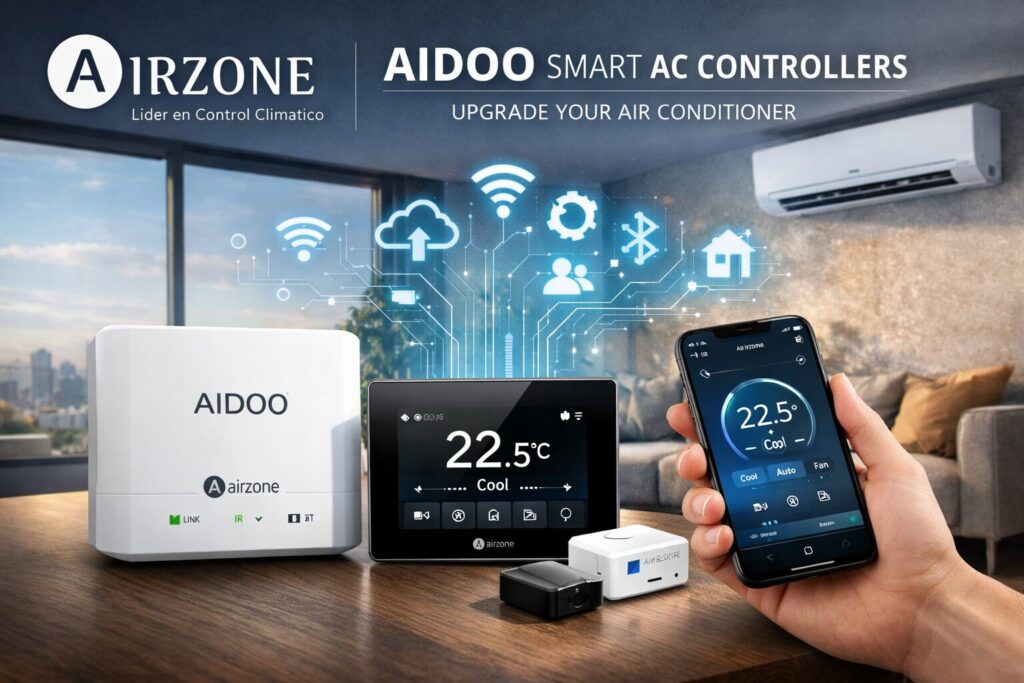
Airzone, the Spanish climate control specialist with nearly 30 years of experience, has cemented itself as a true leader in the HVAC industry. While they cut their teeth on innovative zoned climate control using motorized dampers, their deep dive into the IoT world has led to one of the most robust solutions on the market for upgrading any air conditioner: the Airzone Aidoo family. If you’re looking for a serious smart AC controller, this is a name you need to know.
What is Airzone Aidoo and What Makes It Different?
Unlike the cheap smart AC remotes that just blast Infrared (IR) signals, an Aidoo is a device that connects directly via a cable to your HVAC unit’s internal communication bus (whether it’s a mini-split, ducted system, air-to-water heat pump, etc.). This hardwired connection gives it a critical advantage: true bidirectional control.
This means the Aidoo doesn’t just send commands (turn on, change temp); it also receives real, accurate feedback from the unit itself: its current state (on/off), probe temperature, operating mode, fan speed, and even error codes. Say goodbye to the frustrating sync issues where your app says one thing and your AC is doing another. With an Airzone Aidoo, you have absolute control and a guaranteed source of truth at all times.
Airzone’s Evolution: From Zoned Control to a Connected Ecosystem
Airzone’s philosophy has always been about efficiency and comfort. Their zoning systems, managed by stylish thermostats like the elegant Airzone Blueface, have allowed for independent room-by-room climate control for years, generating significant energy savings. The Aidoo product line represents the expansion of this intelligence to individual HVAC units, turning “dumb” equipment into fully integrated devices for the 2026 smart home.
Aidoo Pro vs. Aidoo WiFi & Other Models: 2026 Comparison Chart
Choosing the right Aidoo is key. While the WiFi model is perfect for simple, direct control, the Aidoo Pro unlocks a world of advanced integrations and control over complex systems like heat pumps. With the Zigbee model now a mature part of the lineup, the family is more complete than ever. I’ve put together this table to break down the differences:
| Feature | Aidoo WiFi | Aidoo Pro | Aidoo Zigbee | Aidoo KNX |
|---|---|---|---|---|
| Primary Connectivity | Wi-Fi 2.4 GHz | Wi-Fi 2.4 GHz | Zigbee 3.0 | KNX Bus |
| App Control | Yes (Airzone Cloud) | Yes (Airzone Cloud) | Via Zigbee Hub | Via KNX System |
| Voice Assistants | Google Assistant, Alexa | Google Assistant, Alexa | Yes (via Hub) | Yes (via KNX gateway) |
| Smart Home Integration | No (Cloud API only) | Yes (Local API): Home Assistant, Fibaro, Crestron, Lutron, etc. | Yes (Zigbee Standard): Zigbee2MQTT, ZHA, etc. | Native KNX |
| Heat Pump Control | No | Yes (Daikin Altherma, Mitsubishi Ecodan, etc.) | No | Yes |
| BMS Protocols | Modbus RTU | Modbus RTU, BACnet MSTP | No | Native KNX |
| Extra Inputs | No | Yes (external thermostat, window contact) | No | No |
| Best For… | Homeowners looking for simple remote and voice control. | Smart home power users, pros, and anyone with a heat pump system. | Users with a robust Zigbee network who demand local, fast control. | Professional and commercial buildings running on a KNX system. |
| Estimated Price Range | $100 – $150 | $180 – $250 | $120 – $170 | $250 – $350 |
Which AC Units Are Compatible with Airzone Aidoo?
Compatibility is one of Airzone’s greatest strengths, but it’s also the most critical thing to check before you buy. They cover the vast majority of brands on the market: Daikin, Mitsubishi Electric, Fujitsu, LG, Panasonic, Hitachi, Gree, Midea, and many more. However, compatibility depends on the exact model of your indoor unit.
My advice here is non-negotiable: before you even think about buying, use the official compatibility tool on the Airzone website. Just enter your unit’s make and model, and the site will tell you exactly which Aidoo device you need and confirm that it’s compatible.
Quick Installation Guide: My Steps and Tips
I’ve installed several Aidoo devices, and the process is pretty straightforward if you have some basic DIY skills. Here are the steps I follow:
- Safety First: Kill the power to your air conditioner from your home’s circuit breaker panel. I can’t stress this enough!
- Access the Indoor Unit: Remove the plastic casing from the indoor unit (the mini-split head) to access the main electronics board.
- Make the Connection: Locate the specific port for external control (often labeled CN105 on Mitsubishi, S21 on Daikin, etc.). Connect the cable included with the Aidoo to this port and to the corresponding jack on the Aidoo device.
- Power Up: The Aidoo is powered directly by the HVAC unit itself, so no extra plugs or power adapters are needed.
- Configuration: Turn the power back on at the breaker. The Aidoo will create a temporary Wi-Fi network. Connect to it with your phone and follow the steps in the Airzone Cloud app to get it onto your home Wi-Fi and linked to your account.
While the process is simple, if you’re not comfortable working with your unit’s electronics, my advice is to have a qualified HVAC technician install it.
Energy Savings and Return on Investment (ROI)
A smart Wi-Fi thermostat like the Airzone Aidoo isn’t just about convenience; it’s about efficiency. The ability to create schedules, remotely shut down a unit you forgot to turn off, or tweak the temperature from anywhere has a direct impact on your utility bill. In my own systems, I’ve observed savings that range from 15% to 30% on cooling and heating costs.
Doing some quick math, a device that costs between $100 and $250 can pay for itself in just one or two sweltering summers, making it a genuinely smart mid-term investment.
Practical Use Cases That Will Win You Over
- The Commuter: You’re leaving work on a scorching hot day. About 15 minutes before you get home, you turn on the AC from your phone. You walk into a perfectly cool, comfortable house without having wasted a single kilowatt.
- The Smart Family: Using Alexa or Google Home routines, the living room AC automatically shuts off when everyone goes to bed, and the bedroom units adjust to a gentle, sleep-friendly temperature.
- The Power User: This is my favorite scenario. Thanks to the Home Assistant integration with my Aidoo Pro, I have advanced automations: if my bedroom window sensor has been open for more than 3 minutes, the AC in that room shuts off, and I get a notification. If you want to learn what Home Assistant is and how to get started, I’ve got a guide for that.
“Ever since I installed the Aidoo Zigbee on my Daikin mini-split, the control is instantaneous. Integrating it into my network with Zigbee2MQTT took minutes, and now it’s part of all my climate scenes. A 10/10 product!” – A happy Tecnoyfoto reader.
The Verdict: Is the Airzone Aidoo Worth It in 2026?
Without a doubt, yes. In 2026, the Airzone Aidoo remains the most professional, reliable, and powerful way to add intelligence to an HVAC system. Its bidirectional, hardwired control places it leagues above IR-based alternatives, offering a rock-solid user experience and unmatched integration potential, especially with the Pro and Zigbee versions.
If you’re looking for basic remote and voice control, the Aidoo WiFi is your best bet. If you’re a smart home enthusiast, need to control a heat pump, or want maximum flexibility, the Aidoo Pro is the investment you should make. And if you’re already living in the Zigbee ecosystem, the Aidoo Zigbee will give you that local, ultra-responsive control you crave.