
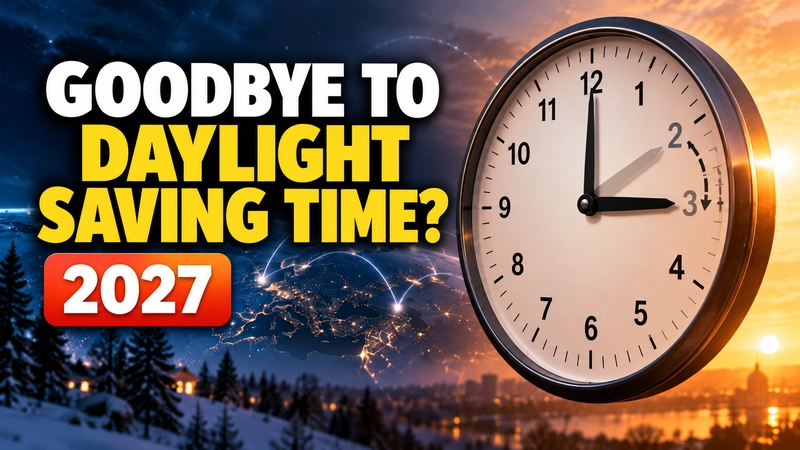

Is daylight saving time ending in 2027? If you have seen headlines suggesting the world is about to stop changing its clocks, you might think we are finally saying goodbye to the twice-yearly switch between standard time and daylight saving time.
But that is not what international timekeepers have decided.
On October 15, 2026, the General Conference on Weights and Measures approved an important change to how the world keeps time. Starting May 20, 2027, Coordinated Universal Time (UTC) will operate as a continuous time scale, without the occasional one-second adjustments known as leap seconds.
That decision does not end daylight saving time in the United States, Europe, or anywhere else that currently observes seasonal clock changes.
There is, however, an interesting technology story behind it. A single extra second can cause real headaches for computers, servers, communication networks, and other connected systems. Let’s break down what is happening and what it means for your devices.
Is daylight saving time ending in the United States in 2027?
No. Under U.S. federal law as of October 2026, daylight saving time is still scheduled for 2027 in the states and areas that observe it.
In most of the United States, clocks move forward on the second Sunday in March and move back on the first Sunday in November. The upcoming dates are:
| Date | Clock change in most of the United States |
|---|---|
| November 1, 2026 | Daylight saving time ends: clocks fall back one hour |
| March 14, 2027 | Daylight saving time begins: clocks spring forward one hour |
| November 7, 2027 | Daylight saving time ends: clocks fall back one hour |
When daylight saving time ends on November 1, 2026, local clocks go from 2:00 a.m. back to 1:00 a.m. When it begins on March 14, 2027, they jump from 2:00 a.m. to 3:00 a.m.
Not every part of the country makes these changes. Hawaii and most of Arizona stay on standard time year-round; the Navajo Nation is a notable exception within Arizona. Several U.S. territories, including Puerto Rico, also do not observe daylight saving time.
There have been repeated proposals to stop changing the clocks, but the international decision about UTC does not change the U.S. daylight saving time rules. Any change to those rules would require its own legal process.
What about Spain and the rest of Europe?
Europe has a different schedule. Under the European Union’s published calendar, daylight saving time ends on October 25, 2026 and the 2027 changes are scheduled for March 28 and October 31.
For mainland Spain, the October change moves the clock from 3:00 a.m. back to 2:00 a.m., rather than the 2:00-to-1:00 a.m. change in most U.S. locations.
The European Commission has published a summer-time calendar through 2031, although future legislation could still change the rules. The key point is the same on both sides of the Atlantic: ending leap seconds does not eliminate seasonal clock changes.
What will actually change on May 20, 2027?
To understand the announcement, we first need to know what Coordinated Universal Time (UTC) is.
UTC is the common time reference that helps keep clocks and computer systems synchronized around the world. It is used behind the scenes by countless digital services, even when your phone or laptop displays a local time such as Eastern, Central, Mountain, or Pacific Time.
The tricky part is that Earth does not rotate at a perfectly constant rate. Its rotation varies slightly because of influences such as the oceans, atmosphere, and movement inside the planet.
Atomic clocks, on the other hand, measure time with remarkable consistency. Over long periods, time based on Earth’s rotation and time kept by atomic clocks can drift apart.
For decades, the solution has been an occasional correction called a leap second. That is the adjustment being retired in 2027.
What is a leap second?
Imagine two extremely accurate clocks. One follows atomic time, and the other represents time based on Earth’s rotation. They usually stay very close together, but their tiny differences can gradually accumulate.
Beginning in 1972, international timekeepers occasionally inserted an extra second into UTC to keep it aligned with Earth’s rotation.
During one of those adjustments, the sequence could look like this:
11:59:59 p.m. → 11:59:60 p.m. → 12:00:00 a.m.
Yes, that means a minute can technically contain 61 seconds.
A total of 27 positive leap seconds have been introduced since 1972. The most recent was added at the end of December 31, 2016.
Most people never noticed. Their phones and computers handled the change, or the effect was hidden by the services that synchronized their clocks. For some complex systems, however, that extra second was a problem.
Why can a single second cause computer problems?
One second sounds insignificant in everyday life. But consider systems that process thousands of transactions, correlate security events, coordinate network traffic, or record events across multiple servers.
Those systems depend on time moving forward in a predictable way.
When a leap second occurs, software must know how to handle a minute that does not behave normally. Some programs and services have handled leap seconds differently, creating mismatched timestamps, unexpected calculations, or occasional outages.
Some major technology providers adopted a workaround called leap smear. Instead of inserting a full extra second at once, their systems spread the correction across a longer period. This can avoid an abrupt time jump, but different approaches can temporarily disagree with one another.
The bigger concern: a negative leap second
Every leap second actually used so far has been positive: timekeepers added a second.
But changes in Earth’s rotation mean that a negative leap second—removing a second—could theoretically become necessary.
That has never happened in practice, so many systems have not been tested for it. International experts identified the risk of an untested negative adjustment as one reason to bring forward the transition to continuous UTC.
The original plan was to make the transition no later than 2035. The new decision sets the effective date at May 20, 2027.
What does continuous UTC actually mean?
From May 20, 2027 onward, UTC will no longer require the insertion or deletion of leap seconds to stay within the old, sub-second limit relative to Earth’s rotation.
The difference between UTC and time based on Earth’s rotation, known as UT1, will be allowed to grow gradually. The international resolution sets a maximum permitted difference of 3,600 seconds, or one hour.
That does not mean all clocks will suddenly shift by one hour in 2027. It does not mean that anyone has scheduled a one-hour correction on that date. Any substantial difference would develop over a very long period, and decisions about a possible future adjustment are not an immediate concern for ordinary users.
There is another important distinction: UTC is not being invented in 2027. It has been the global reference for decades. What changes is how that reference is kept continuous.
Time zones will still exist. Your local clock in New York, Los Angeles, Madrid, or London will continue to display local civil time according to the rules that apply there.
How will the 2027 UTC change affect our devices?
This is where the story becomes especially relevant for Tecnoyfoto readers.
Homes are filled with technology that relies on accurate time: Windows computers, smartphones, routers, NAS servers, security cameras, and smart home platforms all need to know when events happen.
Windows PCs, iPhones, and Android phones
Modern computers and phones generally synchronize their clocks automatically through network time services. One widely used method is the Network Time Protocol (NTP).
The device uses a reliable time source to keep its internal clock reasonably accurate, then applies the appropriate time zone rules to display local time.
Continuous UTC is designed to simplify the underlying timekeeping infrastructure. Most home users should not have to make any special changes on May 20, 2027, provided their systems and time services are properly maintained.
And because seasonal time changes are a separate issue, phones and computers in areas that observe daylight saving time will still switch between standard time and daylight saving time as usual.
Routers, NAS servers, and security cameras
Accurate timestamps matter when troubleshooting a network or reviewing security recordings.
Imagine a security camera logging motion at 6:35 p.m. while your NAS records the related event a few seconds earlier because the two devices have not synchronized their clocks correctly.
You might struggle to reconstruct the correct order of events.
Eliminating leap seconds will not automatically solve every synchronization problem, but it removes one exceptional case that software and time services have had to handle.
Home Assistant and smart home automations
Smart home systems rely on time for scheduled automations, event histories, alarms, and routines.
For example, Home Assistant can turn on lights at a particular hour, run a nightly backup, or activate an automation based on a time schedule.
The 2027 change to UTC is not expected to require ordinary users to rewrite these automations.
Daylight saving time transitions are different. In the fall, some local times happen twice. During the spring transition, certain local times do not occur at all.
If you schedule something for 1:30 a.m. during the U.S. fall change or 2:30 a.m. during the spring change, the result may depend on the software, time zone, and specific automation configuration.
That issue will still exist after leap seconds are retired. It is a good reason to use the correct time zone and test time-sensitive automations around seasonal changes.
Will you need to change any settings in 2027?
For a typical household, probably not. The transition is primarily a change for timekeeping services and the infrastructure that depends on them.
It is still worth following a few basic practices:
- Keep your operating systems, routers, servers, and smart home software up to date.
- Use a reliable time synchronization service, where your device supports one.
- Check that each device is set to the correct time zone.
- If log timestamps disagree across devices, investigate their synchronization settings before assuming an event happened at the displayed time.
Remember that accurate UTC synchronization and correct local time zone settings are not the same thing. A device can have a perfectly accurate internal clock and still show the wrong local time if its time zone is set incorrectly.
So when will daylight saving time finally end?
That remains a separate political and legal question.
In the United States, changing the federal rules for daylight saving time would require a separate legislative decision. In the European Union, proposals to end the twice-yearly clock change have been discussed for years, but the current rules have not been replaced.
Whether a country eventually adopts permanent standard time, permanent daylight saving time, or another approach has nothing to do with the retirement of leap seconds.
The 2027 UTC decision is about making the global time reference more predictable for technology—not choosing how much daylight we get after work.
Frequently asked questions about daylight saving time in 2027
Is daylight saving time being canceled worldwide in 2027?
No. The 2027 international decision concerns leap seconds in UTC, not daylight saving time laws. Countries and regions will continue to follow their own time zone rules.
When does daylight saving time end in the U.S. in 2026?
In most U.S. locations that observe it, daylight saving time ends on Sunday, November 1, 2026, when clocks move back from 2:00 a.m. to 1:00 a.m.
When does daylight saving time start and end in 2027?
In most of the United States, it is scheduled to start on March 14, 2027, and end on November 7, 2027, unless the law changes.
What is disappearing in 2027: daylight saving time or leap seconds?
Leap seconds. Continuous UTC takes effect on May 20, 2027. Seasonal clock changes are not part of that decision.
Will everyone have the same time after 2027?
No. UTC remains the common global reference, while local time zones and daylight saving time rules continue to determine the time shown on clocks around the world.
Do I need to update Home Assistant, my phone, or my PC manually?
Most users should not need to make a special change for continuous UTC. Regular software updates and accurate time zone settings remain the sensible approach.
Final thoughts: timekeeping is changing, but our seasonal clocks are not
The decision to retire leap seconds is a meaningful step toward more predictable timekeeping for computers, networks, and critical infrastructure.
But it does not mean the United States or Europe will automatically stop switching between standard time and daylight saving time in 2027.
The fascinating part of this story is how a single second—something we barely notice—can become a serious technical challenge when millions of connected devices need to agree on exactly when something happened.
Would you rather keep changing the clocks twice a year, stay on standard time year-round, or have permanent daylight saving time? Let us know in the comments.
Continue reading

Next related guide · 10 min read
How to Use Your Own Router with Movistar After the 2026 ONT Changes
Updated August 19, 2026 Have you received a warning that your ONT will stop working? If you have arrived at this article because Movistar…
Continue with this article