

Updated August 16, 2026 · Rebuilt to distinguish the ESP8266, the original ESP32, and today’s broader ESP32 family.
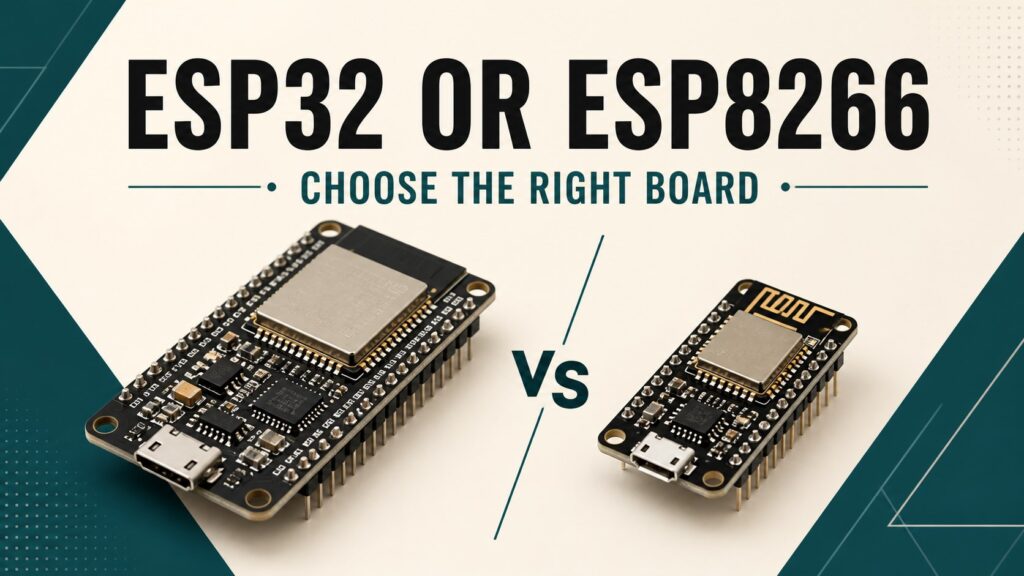
An ESP32 vs ESP8266 comparison is no longer a choice between two nearly interchangeable chips. ESP8266 remains an inexpensive WiFi platform for basic nodes, while ESP32 has grown into a family that includes C3, C6, S2, S3, H2, and other variants with different processors, radios, and peripherals.
For most new ESPHome projects, an ESP32 board offers more memory, headroom, and expansion options. ESP8266 is not useless or automatically obsolete; it is still a sensible fit for simple sensors, relays, and existing WiFi hardware.
The short recommendation
- Choose ESP8266 when you already own the board and only need WiFi, a few GPIOs, and a light configuration.
- Choose ESP32-C3 for a modern low-cost node with WiFi and Bluetooth LE.
- Choose the original ESP32 for many pins, Bluetooth Classic, or compatibility with an existing design.
- Choose ESP32-S3 for USB, displays, audio, cameras, or PSRAM-equipped boards.
- Choose ESP32-C6/H2 when Thread or Zigbee is part of the plan, after checking the exact ESPHome component support.
ESP32 vs ESP8266 comparison table
| Feature | ESP8266 | Original ESP32 |
|---|---|---|
| CPU | Single-core Tensilica L106, 80/160 MHz depending on configuration | Usually dual-core Xtensa LX6, up to 240 MHz |
| RAM | Very limited and shared with the WiFi stack | 520 KB on-chip SRAM and more practical headroom |
| WiFi | 2.4 GHz 802.11 b/g/n | 2.4 GHz 802.11 b/g/n |
| Bluetooth | None | Bluetooth Classic and BLE 4.2 |
| GPIO/peripherals | Few comfortable pins and one ADC | More GPIO, ADC, DAC, touch, I²S, UART, SPI, and I²C |
| Low power | Deep sleep available; board design matters | More sleep options and low-power coprocessors |
| ESPHome role | Good for basic nodes | Primary platform for new development |
Chip specifications do not describe the entire development board. The voltage regulator, USB bridge, LEDs, and power design affect total consumption, acceptable input voltage, and available pins.
Processing power and memory
ESP8266 was designed for low-cost WiFi devices. Its single core and available memory are enough for a relay, a probe, or several basic sensors. Displays, Bluetooth proxies, audio, large web pages, and complex component sets can exhaust its headroom.
The original ESP32 adds clock speed, RAM, and parallel processing. Newer variants change the architecture: ESP32-C3 and C6 use RISC-V, while ESP32-S3 uses Xtensa LX7 and is often sold with PSRAM. Never assume a firmware image, pinout, or peripheral from the original ESP32 applies to every ESP32 model.
WiFi, Bluetooth, Thread, and Zigbee
Both classic chips provide 2.4 GHz WiFi. ESP8266 has no Bluetooth. The original ESP32 supports BLE and Bluetooth Classic; C3 and S3 provide BLE but not Classic. ESP32-C6 adds 2.4 GHz WiFi 6 and an 802.15.4 radio for Thread/Zigbee, while ESP32-H2 drops WiFi and focuses on 802.15.4 plus BLE.
A radio in the silicon does not guarantee that every feature is exposed by a particular ESPHome component. Check the current platform and component pages before purchasing hardware.
GPIO, ADC, and buses
On ESP8266, GPIO0, GPIO2, and GPIO15 affect boot mode; GPIO6 through GPIO11 are normally connected to flash. The bare-chip ADC accepts roughly 0–1 V, although NodeMCU and D1 mini boards may include a divider for an external range around 3.2–3.3 V.
ESP32 offers more inputs and hardware buses, but it also has strapping and reserved pins that vary by chip. On the original ESP32, ADC2 can conflict with WiFi. A generic pin chart is never a substitute for the board schematic.
Power consumption depends on the board
Both families can use deep sleep, but development boards are not necessarily optimized for batteries. A high-quiescent-current regulator, USB bridge, or always-on power LED can draw more current than the sleeping microcontroller.
For a battery node, measure the complete board over its real duty cycle. For a permanently powered USB node, stability, available memory, and support may matter more than the lowest sleep current.
ESPHome configuration examples
Most components can keep the same structure, but the platform block and pins change. A D1 mini based on ESP8266 begins like this:
esphome:
  name: esp8266-node

esp8266:
  board: d1_mini

logger:

api:
  encryption:
    key: !secret api_encryption_key

ota:
  - platform: esphome
    password: !secret ota_password

wifi:
  ssid: !secret wifi_ssid
  password: !secret wifi_password
A generic board using the original ESP32 begins like this:
esphome:
  name: esp32-node

esp32:
  board: esp32dev

logger:

api:
  encryption:
    key: !secret api_encryption_key

ota:
  - platform: esphome
    password: !secret ota_password

wifi:
  ssid: !secret wifi_ssid
  password: !secret wifi_password
Do not convert a project by changing only esp8266 to esp32. Recheck the board ID, GPIO numbers, ADC behavior, buses, and every platform-specific feature.
Where ESP8266 still makes sense
- A powered door contact or leak detector.
- A simple relay with a local button.
- A small set of I²C or 1-Wire sensors.
- An existing retail device or installed board.
- Learning projects where cost and simplicity matter most.
Where ESP32 is the better choice
- Bluetooth proxy, BLE tracking, or Bluetooth communication.
- Large displays, audio, voice, cameras, or complex LEDs.
- Many GPIOs, UARTs, or buses at the same time.
- A configuration already near ESP8266 limits.
- A new design expected to grow over time.
Common comparison mistakes
- Treating the entire ESP32 family as the original ESP32.
- Counting package pins as usable board GPIOs.
- Comparing chip sleep current with complete USB-board current.
- Assuming every ADC input accepts 3.3 V.
- Buying based on core count without checking radios, peripherals, and support.
Related guides
Checked sources
- ESPHome platform recommendations.
- ESP8266 platform, GPIO, and boot modes.
- ESPHome board selection.
- Espressif chip-family comparison.
Frequently asked questions
Is ESP32 always more stable?
No. Stability depends on the power supply, board, firmware, RF environment, and design. ESP32 simply offers more headroom for demanding configurations.
Can I reuse the same YAML?
You can reuse the structure, but must adapt the platform, board ID, pins, and platform-specific components.
Will ESP8266 stop working with ESPHome?
It remains supported and useful for basic projects. New development focuses on ESP32, so ESP8266 is no longer the default purchase for an ambitious build.
The right decision is not simply the fastest chip. Choose the board that covers radio, pins, memory, and power with reasonable margin. ESP32 usually wins for new purchases; ESP8266 remains valuable for simple nodes that already work.