
As an Amazon Associate, I earn from qualifying purchases. En calidad de Afiliado de Amazon, obtengo ingresos por las compras adscritas que cumplen los requisitos aplicables. If you buy through these links, the price is the same for you and Amazon pays me a small commission that helps keep Tecnoyfoto running.

Last updated on January 29, 2026
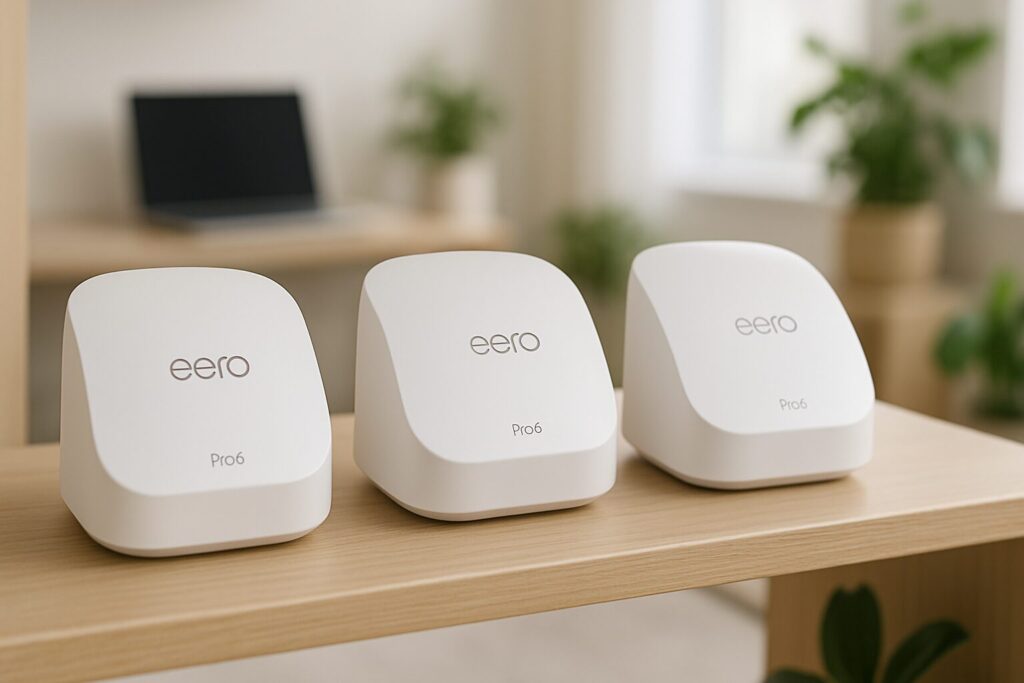
The Amazon eero Pro 6 was a game-changer for mesh networking when it launched, and deep into 2026, it’s still a hot topic. While newer standards have emerged, its killer combo of performance, dead-simple setup, and current price point keeps it firmly in the conversation. In this in-depth eero Pro 6 review, we’ll break down its features and performance to see if it’s still a worthwhile investment against its more modern rivals.
Amazon eero Pro 6 in 2026: Is It Still a Solid Buy?
The short answer is: for a lot of homes, absolutely. If your internet plan is 1 Gbps or less and you’re looking for a rock-solid, easy-to-manage WiFi network with fantastic coverage, the eero Pro 6 is still a beast. Its value proposition has shifted—it’s no longer a high-end flagship but has gracefully aged into one of the best upper-mid-range values on the market today.
Key Features That Still Hold Up
Wi-Fi 6 Standard (AX4200)
Sure, we’re all talking about Wi-Fi 7 in 2026, but let’s be real: Wi-Fi 6 is more than enough for the vast majority of users. The eero Pro 6’s tri-band system dedicates one of its 5 GHz bands exclusively for communication between the nodes (the backhaul). This is a critical feature that prevents your speed from tanking as you connect more devices, setting it apart from cheaper dual-band systems.
Built-in Zigbee Hub: Your Smart Home’s Secret Weapon
This is, without a doubt, one of its killer features. The integrated Zigbee smart home hub lets you directly connect compatible light bulbs, plugs, sensors, and other Alexa-friendly IoT devices without needing a separate hub for each brand. If you’re building a smart home with platforms like Home Assistant, this router saves you from buying a dedicated coordinator, centralizing your mesh network and your Zigbee devices into one slick package.
TrueMesh Technology & Dead-Simple Setup
The eero Pro 6 setup process is its biggest competitive advantage. Unbox it, download the app, and follow the on-screen prompts. The whole thing takes less than 10 minutes. Its TrueMesh technology intelligently optimizes data routes, re-routing traffic to avoid interference and ensuring every device connects to the strongest possible node. For a deeper dive into the tech, check out our guide on the best mesh WiFi systems.
eero Pro 6 Real-World Speed and Performance Tests
To evaluate the real-world speed of the eero Pro 6, I ran several tests in my home on a 1 Gbps fiber connection. The results show seriously solid performance for its price class.
| Test Location | Download Speed (Mbps) | Upload Speed (Mbps) | Ping (ms) |
|---|---|---|---|
| Next to the main router (same room) | 935 | 940 | 4 |
| 30 ft. from main router (1 wall) | 710 | 680 | 6 |
| Connected to a satellite node (upstairs) | 580 | 550 | 8 |
As you can see, performance is excellent near the main node and remains robust through the satellites—more than enough for 8K streaming, online gaming, and dozens of devices connected at once.
Amazon eero Pro 6: The Pros and Cons in 2026
The Good
| The Bad
|
eero Pro 6 vs. The Competition in 2026
To put things in perspective, here’s how the eero Pro 6 stacks up against the eero Pro 6EAffiliate link and other popular alternatives on the market right now.
| Feature | Amazon eero Pro 6 | Amazon eero Pro 6EAffiliate link | TP-Link Deco XE75 | Google Nest Wifi Pro |
|---|---|---|---|---|
| Wi-Fi Standard | Wi-Fi 6 (AX4200) | Wi-Fi 6E (AXE5400) | Wi-Fi 6E (AXE5400) | Wi-Fi 6E (AXE5400) |
| Bands | Tri-Band (2.4 / 5 / 5 GHz) | Tri-Band (2.4 / 5 / 6 GHz) | Tri-Band (2.4 / 5 / 6 GHz) | Tri-Band (2.4 / 5 / 6 GHz) |
| Ethernet Ports (per node) | 2 x 1 Gbps | 1 x 2.5 Gbps + 1 x 1 Gbps | 3 x 1 Gbps | 2 x 1 Gbps |
| Smart Home Hub | Zigbee | Zigbee | None | Thread |
| Estimated Price (3-Pack) | $250 – $350 | $400 – $500 | $380 – $480 | $350 – $450 |
The Verdict: Who Should Buy the Amazon eero Pro 6 in 2026?
The price of the eero Pro 6 has dropped significantly, making it one of the smartest buys in the mesh networking space today. While it lacks the 6 GHz band of newer 6E models, its performance on the 5 GHz bands is exceptional thanks to that dedicated backhaul—a feature many cheaper systems skip.
Here’s my final take:
- You should buy it if: Your top priority is a “set it and forget it” WiFi network that just works. If you have an internet plan up to 1 Gbps and you value the Alexa ecosystem and the built-in Zigbee hub for your smart home, this is a no-brainer. It’s perfect for families and non-technical users who want maximum coverage and stability without the headaches.
- You should look elsewhere if: You’re a power user who needs total control over your network (like network segmentation, advanced QoS settings, etc.), you have an internet connection faster than 1 Gbps, or you live in a very crowded apartment building where the 6 GHz band of Wi-Fi 6E would make a real difference.
In conclusion, the Amazon eero Pro 6 has aged like a fine wine. Far from being obsolete, it has repositioned itself in 2026 as a high-performance mesh solution with a price-to-performance ratio that’s tough to beat, especially for those looking to unify their Wi-Fi and Zigbee smart home under one roof.
Continue reading

Next related guide · 7 min read
Amazon Eero Pro 6E Review (2026): The Surprising Verdict on an Aging Champ
Updated on January 29, 2026 When the Amazon Eero Pro 6E first hit the market, it was a trailblazer, bringing the WiFi 6E standard…
Continue with this article