

Last updated on June 21, 2026
What is a Circuit Breaker and What Does It Do?
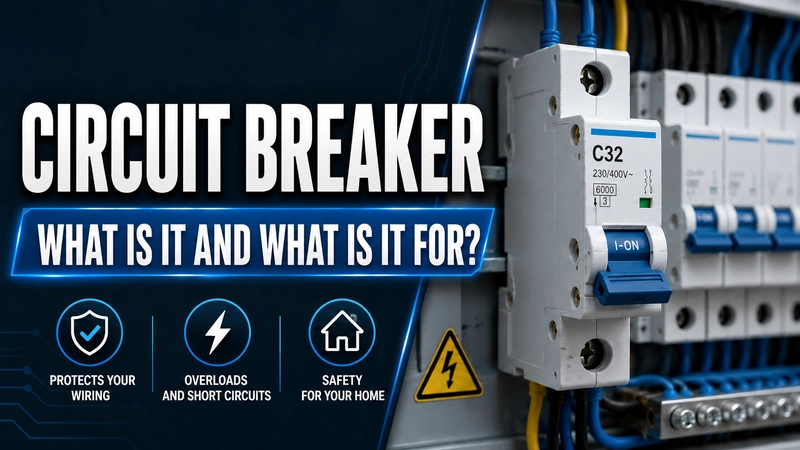
A circuit breaker is the unsung hero of your electrical system. Its mission is simple but absolutely critical: to automatically cut off the flow of electricity when it detects an abnormally high current. This protects your home’s wiring from damage and your expensive electronics from getting fried.
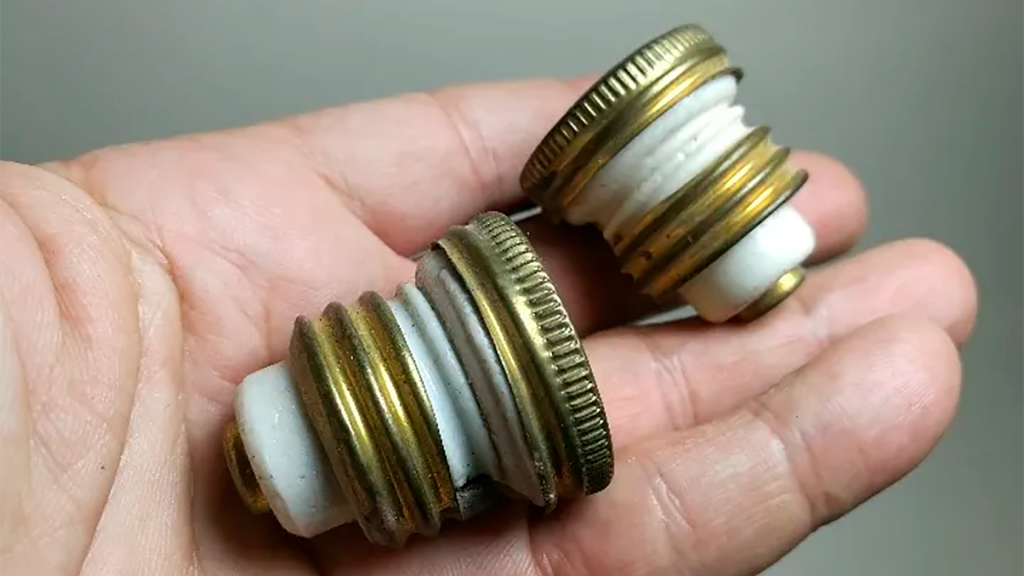
Think of it as the modern, intelligent successor to the old-school screw-in fuses found in vintage homes. Unlike a fuse, which is a one-time-use device that must be replaced after it blows, a circuit breaker can be manually reset once the fault has been corrected, making it a far more convenient and reusable safety component.
The standard breaker in your panel is technically a “thermal-magnetic” circuit breaker, a name that hints at its dual-protection superpower. It integrates two distinct trip mechanisms into a single device, each designed to tackle a specific type of electrical fault.
The Dual-Protection System: How a Circuit Breaker Works
To understand why breakers are so effective, you have to look at the two systems working in tandem to provide complete protection against overcurrent events.
Thermal Protection: The Guardian Against Overloads
This protection mechanism is based on the Joule heating effect and is designed to stop overloads. An overload is a sustained, relatively small increase in current, typically caused by plugging too many high-power devices into a single circuit (e.g., a space heater, a hair dryer, and a vacuum cleaner on the same outlet strip).
Inside the breaker, a bimetallic strip heats up as current passes through it. If the current exceeds the breaker’s rating for a specific amount of time, the heat causes the strip to bend and deform, which physically trips a switch and opens the circuit. This trip is intentionally slow, allowing for brief, harmless current spikes like a motor starting up, but acting decisively against prolonged over-draws that could overheat wires and start a fire.
Magnetic Protection: The Shield Against Short Circuits
Magnetic protection is all about speed and responds to the most immediate danger: a short circuit. A short occurs when a hot wire touches a neutral or ground wire, creating a path of near-zero resistance. This causes an instantaneous and massive surge of current, potentially thousands of amps.
This system uses an electromagnet (a wire coil). When the current skyrockets to short-circuit levels, the intense magnetic field it creates instantly yanks a metal plunger. This plunger strikes the trip mechanism, opening the circuit in a matter of milliseconds. This incredible speed is crucial to preventing catastrophic damage to your electrical system and minimizing the risk of fire or an arc flash explosion.
Breaker vs. GFCI vs. Fuse: Know The Difference
It’s a common mistake to lump these devices together, but they serve different protective roles and are not interchangeable. As an electrical pro, I can’t stress this enough: understanding what each one does is vital for a safe home.
Never confuse a standard circuit breaker with a GFCI or AFCI, whose primary jobs are to protect *people* from shock and the home from electrical fires, respectively.
| Device | Protects Against | Who/What It Protects | How It Works |
|---|---|---|---|
| Standard Circuit Breaker | Overloads & Short Circuits | The home’s wiring and connected appliances | Thermal (bimetallic strip) and Magnetic (electromagnet) |
| GFCI / AFCI Breaker | Ground Faults (GFCI) & Arc Faults (AFCI) | People (from shock) and the building (from fire) | GFCI senses tiny current imbalances. AFCI detects dangerous electrical arcs. |
| Fuse | Overloads & Short Circuits | Wiring and appliances (in a more basic way) | A metal filament melts and breaks the circuit when current is too high. One-time use. |
How to Read a Circuit Breaker: Decoding the Specs
At first glance, the markings on a circuit breaker can look like gibberish, but they’re the key to understanding its capabilities. The most prominent number is the most important one.

- The Big Number (e.g., 15, 20, 30): This is the Amperage Rating (or Amp Rating). It represents the maximum current in Amps (A) that can flow through the breaker continuously without tripping. In this example, 16 Amps.
- Trip Curve Letter (e.g., C): Often seen on international (IEC) breakers, this indicates the sensitivity of the magnetic trip. Type C is a standard curve for general residential use. Most standard US residential breakers don’t prominently feature this letter but behave similarly to a Type C.
So, a breaker marked “20” is a 20-Amp breaker, ideal for a kitchen or laundry circuit with 12 AWG wiring, as required by the National Electrical Code (NEC).
Key Specs for Choosing a Circuit Breaker (2026 Guide)
To select the right breaker, you need to consider four critical characteristics that define its application and performance.
1. Amperage Rating (Amps)
This is the current value in Amps (A) that the breaker can handle indefinitely. This value is chosen to protect the wire size of the circuit. It must never be higher than the maximum amperage the wire can safely carry.
Common values in US homes, according to the NEC, are:
- 15A: For general lighting and outlet circuits (using 14 AWG copper wire).
- 20A: For kitchen, laundry, and garage outlets (using 12 AWG copper wire).
- 30A: For electric dryers and water heaters (using 10 AWG copper wire).
- 40A or 50A: For electric ranges, ovens, or A/C units (using 8 or 6 AWG copper wire).
2. The Trip Curve: The Breaker’s “Personality”
The trip curve defines how much of an overcurrent is needed to trigger the magnetic (instantaneous) trip. This is crucial for preventing “nuisance trips” with certain types of equipment.
- Type B: Fast trip (3 to 5 times the rated current). Used for sensitive electronics or resistive loads with very low startup surge. Rare in US residential panels.
- Type C: Normal trip (5 to 10 times the rated current). This is the behavior of most standard breakers used in US homes and is perfect for general lighting, outlets, and common appliances.
- Type D: Slow trip (10 to 20 times the rated current). Used for circuits with equipment that has a very high inrush current, like large motors, transformers, or well pumps.
3. Circuit Breaker Types by Number of Poles
The number of poles tells you how many energized conductors the device disconnects when it trips.
- Single-Pole (1P): Protects a single hot wire. This is the standard for 120V circuits that power your lights and regular outlets.
- Double-Pole (2P): Protects two hot wires simultaneously. It’s the standard for 240V circuits that power major appliances like your electric range, central A/C, or dryer.
- Three-Pole (3P): Protects three hot wires. Used in three-phase electrical systems, which are common in commercial and industrial settings but extremely rare in homes.
4. Interrupting Rating (AIC)
Expressed in Amps (A) or Kiloamps (kA), this is the maximum short-circuit current that the breaker can safely interrupt without being destroyed. For residential panels, the NEC typically requires a minimum rating of 10,000A (or 10kA). Using a breaker with a lower AIC than what’s available from the utility could cause it to fail catastrophically (weld shut or explode) during a severe short circuit.
How to Choose the Right Circuit Breaker for Your Project
While the NEC defines the breaker sizes for standard home circuits, you might need to protect a new, dedicated circuit. The process I follow as a professional is always the same:
Step 1: Identify the Circuit’s Load
First, figure out what you’re powering. Let’s say you’re adding a dedicated circuit for a home office setup with a powerful computer, monitors, and a laser printer. Add up the wattage (W) of all devices that might run at once. Let’s estimate a maximum load of 1500W.
Step 2: Calculate the Current
Use the power formula derived from Ohm’s Law: Current (I) = Power (P) / Voltage (V).
For a standard US voltage of 120V:
I = 1500W / 120V = 12.5 A
Step 3: Select the Next Standard Size Up
The calculated current is 12.5A. You can’t buy a 12.5A breaker. The next standard size up is 15A. A 10A breaker would trip constantly, so it’s not an option. We choose a 15-Amp breaker.
Step 4: Match the Wire Gauge (The Critical Step!)
The circuit breaker protects the wire. This is the most important rule in wiring. You must ensure the wire for that circuit is thick enough to handle the amperage of the breaker you chose. For a 15A breaker, the NEC mandates a minimum of 14 AWG copper wire.
If you were to install a 20A breaker on a circuit with 14 AWG wire (which is only rated for 15A), you’d create a massive fire hazard. The wire would dangerously overheat long before the breaker ever tripped from an overload.
Troubleshooting: Why Is My Circuit Breaker Tripping?
When a breaker trips, it’s doing its job. Your task is to investigate the cause before just flipping it back on.
- If it tripped from an overload: The breaker handle might feel slightly warm. Unplug some devices from the circuit, wait a minute for the bimetallic strip to cool, and then try resetting it.
- If it tripped from a short circuit: The trip is instant and often makes a loud snap. If you try to reset it and it immediately trips again, you have a persistent short in the wiring or in a connected appliance. Unplug everything from that circuit and try again. If it still trips, the fault is in the home’s wiring, and you need to call an electrician.
How to Test if a Circuit Breaker is Bad
If a breaker won’t reset even with no load, or if it’s in the “ON” position but there’s no power, it could be faulty. Here’s how to safely check:
- Turn off the main breaker to de-energize the entire panel.
- Turn off all the individual circuit breakers, including the suspect one.
- Try to flip only the suspect breaker to the “ON” position. If it feels mushy or won’t mechanically latch, it’s broken.
- If it feels okay but you suspect it’s failing internally, use a multimeter in continuity mode. Place the probes on the input (bus bar clip) and output (screw terminal) of the breaker. It should show no continuity (no beep) when OFF and show continuity (beep) when ON. If it doesn’t beep when ON, its internal contacts are damaged and it must be replaced.
NEVER, EVER PERFORM A CONTINUITY TEST ON A CIRCUIT WITH THE POWER ON.
Frequently Asked Questions (FAQ) About Circuit Breakers
How much does a circuit breaker cost in 2026?
The price depends on the brand, type (standard, GFCI, AFCI), number of poles, and amp rating. For a typical residential panel, a standard single-pole breaker from a reputable brand costs between $8 and $15. A dual-function AFCI/GFCI breaker can cost $50 or more. Be wary of extremely cheap, no-name brands, as the quality of these devices is critical for your safety.
What’s the best brand of circuit breaker?
More important than a specific brand is compatibility. You must use breakers that are designed and listed for use in your specific electrical panel. Common high-quality brands in the US include Square D (Schneider Electric), Eaton, Siemens, and GE. Always install UL-listed devices to ensure they’ve passed rigorous safety testing.
What is the Voltage Rating (Ui)?
This is the maximum voltage for which the breaker’s insulation is designed. It ensures there are no electrical leaks between conductive parts and the outer casing, guaranteeing safety even at voltages higher than the standard operating voltage (Ue) of 120V or 240V.
Conclusion: Your First Line of Electrical Defense
The humble circuit breaker is an inexpensive but absolutely essential component of any modern electrical system. Understanding how it works, how to read its specs, and how to choose the right one isn’t just a technical exercise—it’s a direct investment in the safety of your home, your property, and most importantly, your family. When in doubt, always follow the golden rule of electrical work: consult a qualified, licensed electrician.