
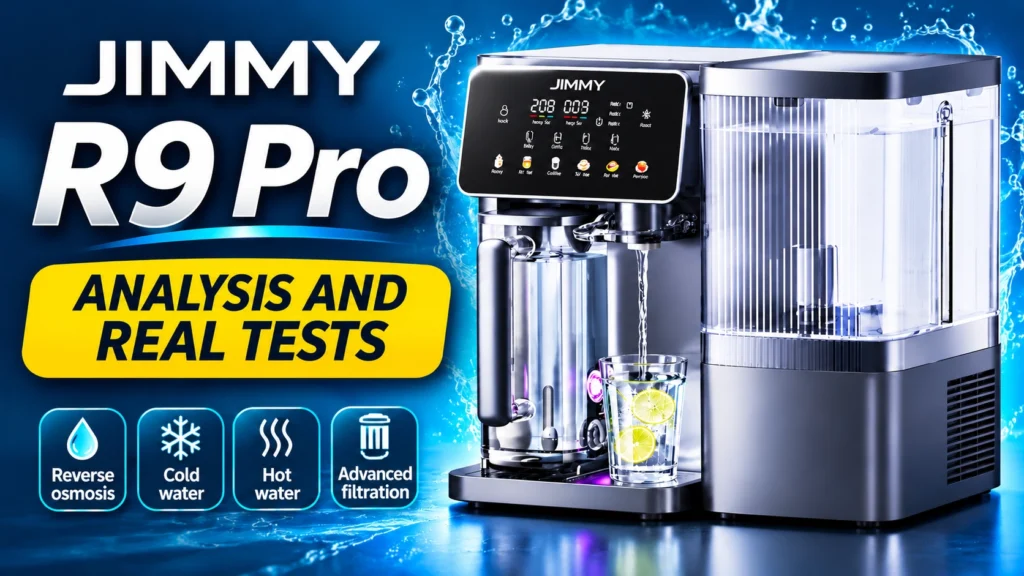

I used the JIMMY R9 Pro for several weeks in my kitchen in Spain. The number that mattered most was how much water I could actually use per refill. I got about 4.3 liters (1.14 US gallons) from the 5.5-liter tank in two checks. Chilled water came out at 55–57°F (13–14°C). Leaving the cooling on was also the biggest difference I noticed in daily energy use and background noise.
JIMMY provided the R9 Pro free of charge for this review. The results and opinions below come from my own household tests.
Full video review (in Spanish)
What it takes to live with the R9 Pro
The R9 Pro is a countertop reverse osmosis water filter. It needs an outlet and a supply of drinkable tap water, with no plumbing connection or drain line. The feed tank holds 5.5 L, and the package comes with two removable 1 L pitchers. The dispenser has 120, 200, 300, and 500 mL presets. I checked the 120 mL setting with a graduated pitcher, and the water reached the level I expected.
You can carry a pitcher to the table and dispense a measured amount at a selected temperature. The trade-off is reaching above the unit to remove the tank and lids, then emptying and refilling the tank when prompted. The touchscreen controls my unit, and I found no phone, internet, or Home Assistant connection. If the main goal is a change in taste, a carbon-filter pitcher might be enough. A plumbed under-sink reverse osmosis system can remove the refill chore if the kitchen allows for installation. JIMMY’s standard R9 lacks the Pro’s built-in cooling. European R9 Pro product page · JIMMY model comparison
I tested the European 220–230 V model, rated at 2,200 W. The manual mentions a separate 120 V version for other markets. Check the model’s nameplate and local listing before buying. The temperatures in my test are the settings and readings from my European unit. The Fahrenheit equivalents of those measurements are separate from the preset labels on a 120 V device. R9 Pro manual
Filters, setup, and upkeep
Pressure drives water through the reverse osmosis membrane and leaves a more concentrated reject stream. Some water returns to the feed tank on this machine. JIMMY advertises seven treatment stages, including UV. Under the cover I found these three cartridges. R9 Pro manual · JIMMY replacement filters
| Cartridge | Role | JIMMY’s suggested interval |
|---|---|---|
| M2S | Microfiber and activated carbon prefilter | 12 months |
| RO-2.0S | Reverse osmosis membrane | 24 months |
| Q2S | Activated carbon and remineralization postfilter | 12 months |
Replacement intervals depend on the incoming water and how much you use. The panel tracks each filter. The manual explains how to turn and remove a cartridge with the power off, reset its individual indicator, and drain three batches from the purified-water pitcher after replacement. The standard Q2S and the separate Q2S-Sr option have different part numbers. R9 Pro manual · JIMMY cartridge catalog
I left the unit overnight after unpacking and washed the pitchers and tank in the meantime. JIMMY recommends 8 to 12 hours of rest before setup. The initial flush uses drinkable municipal tap water and calls for emptying the purified-water pitcher three to five times in the pitcher-based procedure, followed by the cold-water circuit steps. I filled and emptied the pitchers five times. The bubbles I saw in the feed tank at first are described in the manual. The Lock and Cold buttons toggle with a five-second hold. Cooling is off by default. Setup and flushing instructions
When the change-water alert turns on, empty the remaining feed water and refill with fresh tap water. Low level can also trigger the alert. My son asked whether we could run seawater through it. This model is designed for drinkable municipal tap water. I would keep seawater and water from unknown sources out of it. R9 Pro manual
How I tested the water
I used a Measury handheld meter for TDS and conductivity, the JIMMY screen for internal readings, a SONOFF BMT01 kitchen probe for temperature, and a smart plug for energy. I logged sound levels in my home and used visual test strips to compare tap and dispensed water.
A handheld meter estimates total dissolved solids (TDS) from conductivity. It helps compare samples under stated conditions. Claims about the reduction of specific substances, such as lead or PFAS, come from JIMMY and require tests designed for those substances. USGS on dissolved solids · JIMMY product page
Eight-sample water comparison
| Sample | TDS (ppm) | Conductivity (µS/cm) | Temperature (°C) |
|---|---|---|---|
| Tap water | 205 | 410 | 19 |
| JIMMY, dispensed water | 19 | 26 | 20 |
| Bezoya | 15 | 27 | 20 |
| Viladrau | 113 | 233 | 20 |
| Font Vella | 167 | 337 | 20 |
| Solán de Cabras | 232 | 465 | 20 |
| Eliqua 2 sparkling | 153 → 205 | 381 → 390 | 20 → 20 |
| Vichy Catalan sparkling | 143 → 211 | 311 → 348 | 20 → 20 |
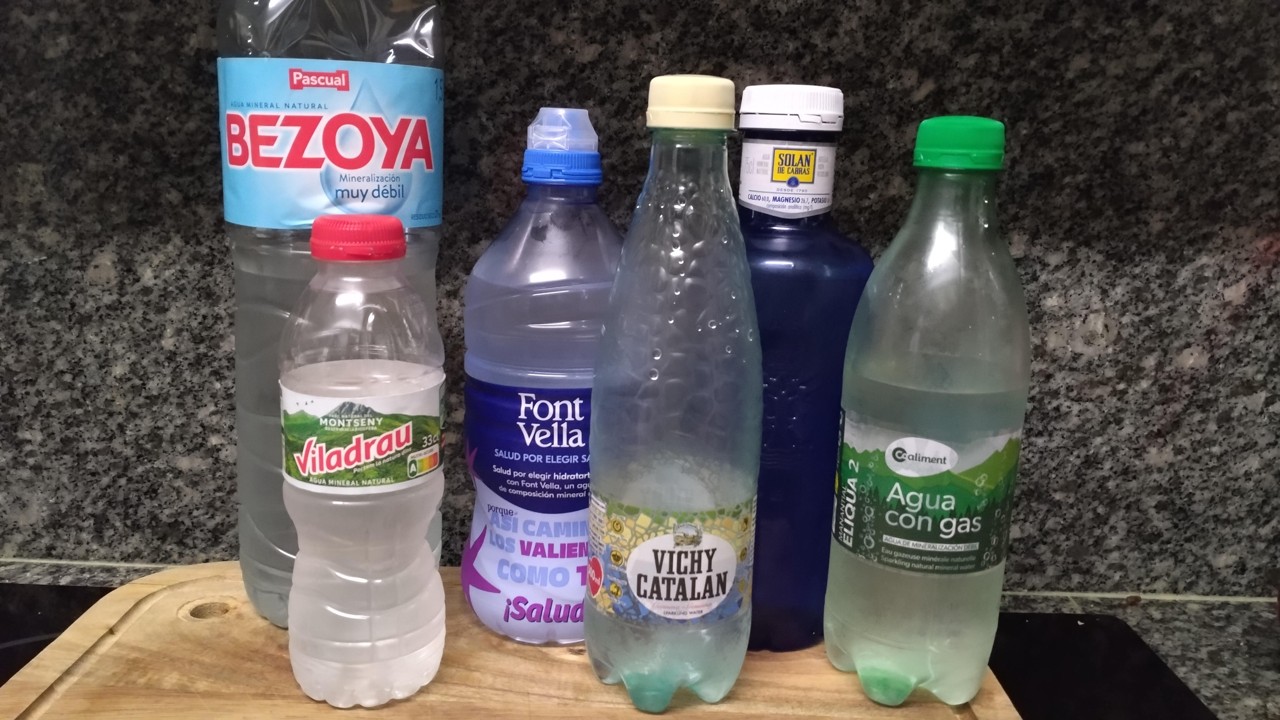
I measured the sparkling samples as soon as I opened them and 25 minutes later. After 15 minutes in a glass, Eliqua 2 still had visible bubbles and Vichy Catalan did not. The arrows show the two readings in order. Bezoya was the closest bottled sample to the JIMMY’s dispensed water by TDS. A similar reading does not establish the same mineral composition. The meter’s estimate also differs in method from the dry residue printed on a bottle label. USGS on dissolved-solids measurement
The screen reading and usable water per refill
In a separate November 18 check, Bronchales measured 22 ppm and 44 µS/cm. I kept that later reading out of the eight-sample comparison.
During an early rinse I saw 327 ppm at the inlet and 008 ppm on the outlet display, a roughly 97.6% reduction for those two readings. In routine use, the display generally showed 2–4 ppm with a fresh feed tank and 7–9 ppm after using some of the tank, occasionally reaching 10. In one session I recorded 9 ppm on the display and measured 17 ppm in the pitcher and 19 ppm after dispensing with the Measury. JIMMY places the outlet sensor after the membrane and before the Q2S postfilter. A handheld reading after remineralization can differ from the number on the screen because the meters sample at different points. JIMMY R9 series FAQ
| Sampling point | Display (ppm) | Measury (ppm) |
|---|---|---|
| Tap water | — | 205 |
| Freshly filled feed tank | 324 | 314 |
| Feed tank at refill alert | 574 | 578 |
| Dispensed water / pitcher, one session | 9 | 17–19 |
In two checks I had about 4.3 L to use and roughly 1.2 L remaining when it was time to refill. That’s 78.18% of the starting volume. In one test, Measury readings in the feed tank rose from 314 to 578 ppm. In another logged session I got 215 ppm from the tap, then 344 ppm on the display and 334 ppm on the external meter in a freshly filled tank. I also recorded an outlet pair of 3 ppm on the display and 14 ppm after dispensing. During startup in a separate session, the display went from 327 to 600 ppm. JIMMY quotes a 3:1 pure-to-drain ratio for the system. My 4.3 L result measures how much I got per tank refill at home. JIMMY specification · EPA WaterSense on reverse osmosis
Visual test strips
I ran two checks on separate days with AAwipes multiparameter strips. I dipped each strip for about two seconds, shook it gently, and compared the colors after about 30 seconds. I noted lighting of about 550 lux in one session.
| Property | Tap water | JIMMY water |
|---|---|---|
| pH | 7.6–7.8 | 6.2–6.8 |
| Alkalinity (mg/L on color chart) | 120–180 | 0–40 |
| Hardness | Visible difference, no reliable number | — |
pH describes acidity or basicity, alkalinity reflects how well water buffers changes in pH, and hardness largely reflects calcium and magnesium. The ranges above came from a color chart. I saw a difference in hardness, but the records do not support assigning it a number. I also did not recover dependable quantitative results for chlorine, nitrates, or other parameters. USGS on alkalinity · USGS on hardness
Hot and cold water at the glass
I made three measurements of 120 mL (about 4.1 US fl oz) at each hot setting with a SONOFF BMT01. I waited ten minutes between settings. Room temperature was about 23°C (73°F). I measured the dispensed water in the glass. My SONOFF BMT01 review in Spanish · Thermometer video
| Setting (°C) | Reading 1 | Reading 2 | Reading 3 | Mean (°C) | Difference (°C) |
|---|---|---|---|---|---|
| 45 | 44 | 46 | 48 | 46.0 | +1.0 |
| 55 | 56 | 56 | 56 | 56.0 | +1.0 |
| 65 | 61 | 64 | 64 | 63.0 | −2.0 |
| 75 | 71 | 74 | 77 | 74.0 | −1.0 |
| 85 | 84 | 84 | 84 | 84.0 | −1.0 |
| 98 | 92 | 95 | 96 | 94.3 | −3.7 |
The 55°C and 85°C settings each gave three matching readings. At the 98°C setting, the water in the glass averaged 94.3°C (about 202°F), with readings of 92–96°C. JIMMY says hot water starts in about three seconds. In my kitchen it came quickly, and I didn’t time the start. The bottle icon denotes a temperature preset. For powdered infant formula, follow the formula instructions and applicable public health guidance. The CDC recommends extra precautions, including hotter water, for babies at higher risk. JIMMY product page · CDC guidance
The chilled output was 13°C and 14°C (about 55°F and 57°F). I liked that temperature for drinking. The indicator flashes while cooling and stays on when ready. JIMMY support describes a roughly 0.55 L chilled tank and estimates about half an hour to reach 15°C from room temperature after emptying the cold supply, or about an hour to reach 10°C under its conditions. A run of back-to-back glasses can warm the next pour. JIMMY cooling FAQ · R9 Pro manual
Energy use and noise
| October 2026 | Cooling | Energy (kWh) | Period |
|---|---|---|---|
| 19 | Off | 0.010 | Full day |
| 20 | Off | 0.009 | Full day |
| 21 | Off | 0.010 | Full day |
| 22 | On | 0.447 | Full day, transition |
| 23 | On | 0.496 | Full day |
| 24 | On | 0.553 | Full day |
| 25 | On | 0.515 | Full day |
| 26 | On | 0.099 | Partial, midnight to 6:13 a.m. |
The video graphic includes spot readings from my smart plug. With cooling off it displayed 0 W at rest and 18–25 W while dispensing and filtering. With cooling on I saw about 60 W while cooling alone and 85 W when it was also filling the pitcher. Those were momentary readings. JIMMY lists 1 W in standby and 100 W of cooling power. JIMMY specifications
The three complete days without cooling averaged 0.00967 kWh per day. The three steady days with cooling averaged 0.52133 kWh per day. The 22nd was the transition day, and the 26th was a partial reading. In the video I also report 0.012 kWh per day over 14 days without cooling, a separate period. The table shows the days with individual readings available. If the two three-day averages held for a year, they would come to about 3.53 and 190.29 kWh, respectively.
| Condition | Measured level |
|---|---|
| Background | 36 dB |
| Cooling | 51.8–52 dB |
| Dispensing | 56 dB |
In my room, the measured level during cooling was about 16 dB above the background level. Decibels use a logarithmic scale, and the result depends on the room and setup. I could hear it cooling, filtering, and dispensing. If you want to put it near a bedroom, consider what those operating sounds would mean for you. OSHA on sound levels and decibels
Could it replace the bottled water you buy?
My example uses three people replacing 4.5 L of bottled water per day, at €0.75 per 1.5 L bottle of Bezoya in Spain. That’s €821.25 a year in bottles. Based on the refill test, serving 4.5 L takes about 5.76 L of tap water. I used €3 per cubic meter of tap water, €0.20/kWh for electricity, and €499 as the purchase-price assumption. The second row adds an illustrative €100 per year for filters.
| Scenario | Annual savings, cooling off | Annual savings, cooling on | Months, cooling off | Months, cooling on |
|---|---|---|---|---|
| Excludes filters | €814.24 | €776.89 | 7.35 | 7.71 |
| With €100/year filter allowance | €714.24 | €676.89 | 8.38 | 8.85 |
I divided the up-front cost by projected annual savings, then multiplied by 12. Annual water cost was about €6.30, and estimated electricity was €0.71 without cooling or €38.06 with cooling. That gives about eight to nine months with my filter allowance at 4.5 L per day. At 3 L per day with the same rates and electricity cost, it rises to about 13.5–14.8 months. Use your own water and energy prices, bottled-water purchases, and replacement-filter costs.
Buying the R9 Pro and my take after weeks of use
JIMMY’s EU store showed €499 as a reference on November 22, 2026. Check availability, voltage, total price, and return terms with the seller for your market. JIMMY EU product and store page
Amazon Spain Black Friday deal
€429.99, down from €499.99. The €70 discount applies automatically, with no promo code required. The offer runs November 19–30, 2026, on Amazon Spain. See the JIMMY R9 Pro on Amazon Spain
Official JIMMY store
Get €70 off with promo code JIMTEC70. JIMMY hasn’t specified an expiration date. Check that the discount is applied before you pay. See the JIMMY R9 Pro at the official store
The water tasted unusual at first. I came to like it enough to fill a bottle at home to take to work. The pitchers, portion presets, and selectable temperatures are what made the R9 Pro useful in my kitchen. I’d base the buying decision on how much bottled water you’d actually replace, whether you’d use the cooling, and how often you can see yourself emptying and refilling the tank.