
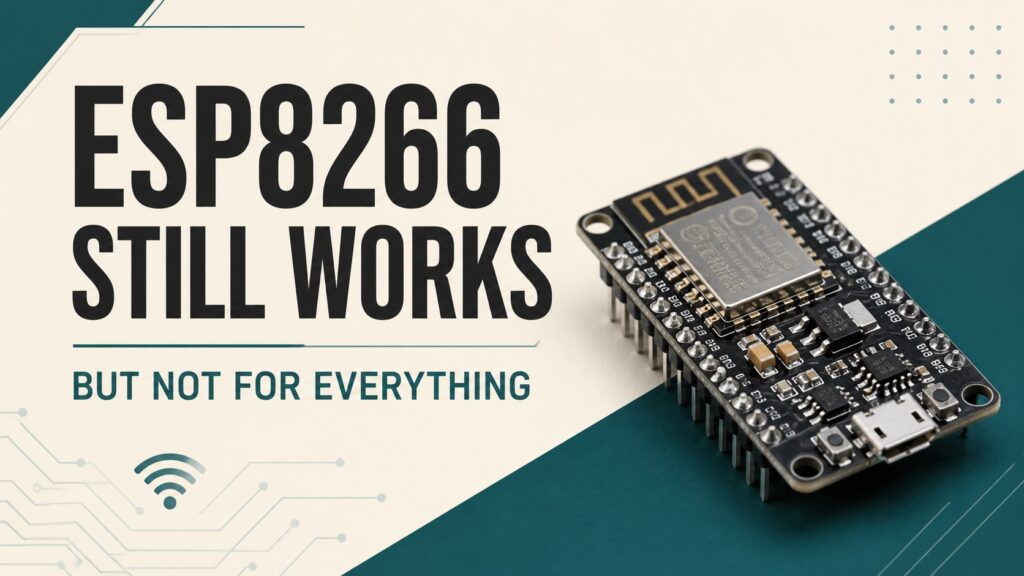

Updated August 17, 2026 · Hardware, boards, GPIO, ADC, power, and current ESPHome configuration reviewed.
The ESP8266 remains one of the best-known WiFi microcontrollers in DIY home automation. It helped make connected sensors and relays inexpensive and still works well with ESPHome. It is no longer the automatic answer for every build, however: memory, pins, and peripherals are much more limited than on the ESP32 family.
This review separates the chip from NodeMCU, Wemos D1 mini, and ESP-01/ESP-12 hardware. A development board adds flash, a regulator, USB, dividers, LEDs, and boot resistors that change the practical specifications.
Quick verdict
ESP8266 is still a good fit for a simple, line-powered WiFi node: door contacts, relays, DS18B20 probes, I²C sensors, and pulse counters. For Bluetooth, audio, demanding displays, many sensors, or future expansion, start with ESP32.
- Best qualities: price, availability, compact boards, mature documentation, and support.
- Main drawbacks: limited RAM, one ADC, boot-sensitive pins, and no Bluetooth.
- Buy it when: the project is basic or it replaces equivalent hardware.
- Keep it when: an installed node is stable and already does the job.
Chip, module, and development board
| Format | What it contains | Typical use |
|---|---|---|
| ESP8266EX | The bare chip | Custom electronics |
| ESP-01 | Small module with few exposed pins | Compact integration and older devices |
| ESP-12E/12F | Module with antenna, flash, and more GPIO | Base for many boards and products |
| NodeMCU | ESP-12, regulator, and USB-to-serial | Prototypes with more exposed pins |
| LOLIN/Wemos D1 mini | Compact USB board with regulator and shields | Small ESPHome nodes |
Commercial names do not guarantee identical revisions. Clones may change the regulator, flash, USB bridge, or ADC divider. Check the schematic of the exact board when an electrical limit matters.
Useful specifications
- 32-bit Tensilica L106 CPU, normally 80 MHz and configurable to 160 MHz.
- 2.4 GHz 802.11 b/g/n WiFi with no Bluetooth.
- External flash, commonly 4 MB on current NodeMCU and D1 mini boards.
- UART, SPI, I²C, PWM, and 1-Wire support as implemented by firmware and board.
- One 10-bit ADC with a bare-chip input range around 0–1 V.
- 3.3 V logic; GPIO pins are not 5 V tolerant.
GPIO and boot-strapping pins
GPIO0, GPIO2, and GPIO15 determine boot mode. Normal flash boot requires HIGH, HIGH, and LOW respectively. An external load that forces another level can prevent startup. GPIO6 through GPIO11 are normally connected to flash and should be avoided.
| GPIO | Practical use | Caution |
|---|---|---|
| GPIO4 / GPIO5 | I²C and general I/O | Usually the easiest pins |
| GPIO12/13/14 | SPI or general I/O | Exposed on ESP-12 and larger boards |
| GPIO0/2/15 | Restricted general I/O | Preserve required boot levels |
| GPIO1/3 | UART TX/RX | Logging can interfere |
| GPIO16 | I/O and deep-sleep wake | Different characteristics and no normal internal pull-up |
The ADC limitation
The bare ESP8266 ADC accepts roughly 0–1 V. Some development boards add a divider ahead of A0 for about 3.2–3.3 V externally. Never connect 5 V or assume that every clone uses the same circuit. Measure or inspect the schematic.
This ADC is not a precision instrument. Supply noise, WiFi, divider tolerance, and calibration affect the result. Use a suitable external ADC for demanding measurements.
Power and stability
WiFi transmit peaks require a stable supply. Random resets and disconnects often point to the regulator, USB cable, or voltage drop. Do not power a board through a GPIO, and do not overload its 3.3 V regulator output with external devices.
A board may accept 5 V through USB or a labeled 5V/VIN pin because it contains a regulator. Its signal pins still use 3.3 V logic and are not made safe for 5 V inputs.
Deep sleep and batteries
ESP8266 supports deep sleep and can wake through GPIO16-to-RST wiring where the board design allows it. On a development board, the regulator, USB bridge, and power LED may dominate sleep current. Measure the complete board before designing around a datasheet figure.
WiFi association and transmission also consume energy. A battery sensor often works best when it wakes, measures, transmits, and sleeps. That cycle must still leave a practical path for firmware updates.
Secure ESPHome configuration
esphome:
  name: esp8266-sensor
  friendly_name: ESP8266 Sensor

esp8266:
  board: nodemcuv2
  early_pin_init: false

logger:

api:
  encryption:
    key: !secret api_encryption_key

ota:
  - platform: esphome
    password: !secret ota_password

wifi:
  ssid: !secret wifi_ssid
  password: !secret wifi_password

sensor:
  - platform: wifi_signal
    name: "WiFi Signal"
    update_interval: 60s

button:
  - platform: restart
    name: "Restart"
early_pin_init: false can prevent early output changes on relay projects during restart, although safe hardware biasing remains necessary. Use board: d1_mini for the matching LOLIN/Wemos board.
Advantages and drawbacks
| Advantages | Drawbacks |
|---|---|
| Very inexpensive and widely available | Limited practical RAM and flash |
| Mature ESPHome support | No Bluetooth |
| Compact USB boards | One ADC with a delicate range |
| Large body of existing projects | Several pins affect boot |
| Enough for simple nodes | Little headroom for demanding modern features |
When to move to ESP32
- The compiler or logs show memory pressure.
- You need Bluetooth, audio, voice, a camera, or native USB.
- You have run out of GPIOs, UARTs, or useful ADC channels.
- You want a Bluetooth proxy or a complex display.
- The new project is expected to grow.
Do not replace a stable node solely because it is old. If it measures or switches reliably and accepts updates, migration may add work without improving the user experience.
Common problems
| Symptom | Likely cause |
|---|---|
| Won’t boot with a relay attached | A strapping pin is held at the wrong level |
| Resets during WiFi activity | Weak supply, regulator, or cable |
| Cannot enter flash mode | GPIO0/BOOT, port, driver, or USB cable |
| A0 is saturated | Input voltage exceeds the board range |
| Garbage at the start of serial output | The ESP8266 bootloader uses 74800 baud |
| OTA image no longer fits | Firmware exceeds available partition space |
Related guides
Checked sources
Frequently asked questions
Is ESP8266 obsolete?
Not for simple existing nodes. It is no longer the most versatile new purchase.
Are its GPIOs 5 V tolerant?
No. Use 3.3 V logic and level-shift higher signals.
Do NodeMCU and D1 mini use identical YAML?
They share ESP8266, but need the correct board ID and pin mapping. Internal GPIO numbers reduce ambiguity.
ESP8266 remains useful when it is kept within its limits. Its best role is solving small, well-documented, electrically safe WiFi tasks—not matching every feature of a modern ESP32.