
This article may contain affiliate links. If you buy through these links, the price is the same for you and the store pays me a small commission that helps keep Tecnoyfoto running.

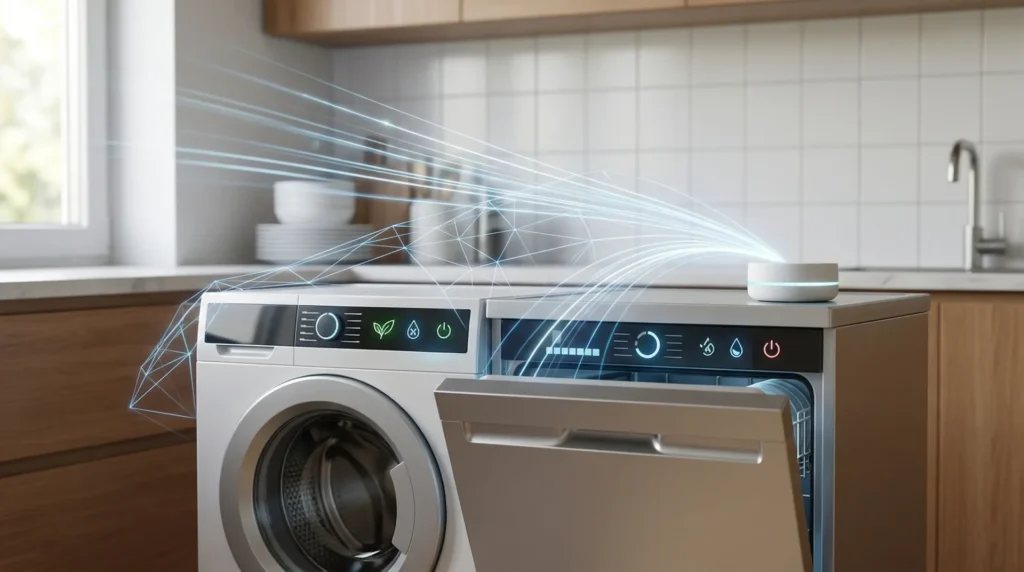
Buying an appliance today that doesn’t have “WiFi” is almost impossible. However, most of these devices are technological islands: they have their own App, depend on their own cloud, and don’t talk to the rest of your home. To make home automation truly useful and mature, the secret lies in choosing Home Assistant compatible appliances that allow us to measure real energy consumption and automate notifications locally, without depending on external servers that can fail at any time.
1. What actually makes an appliance “smart”?
For an appliance to be truly useful in our ecosystem, it must meet at least one of these requirements:
- Local Control: Being able to communicate with the device without going through the manufacturer’s servers (via Matter or local integrations).
- Open API: The manufacturer allows Home Assistant to read its entities (consumption, cycle status, remaining time).
- Load Monitoring: If the device is “dumb,” we can always make it smart by monitoring its power draw.
2. Best Integration Options in 2026
Bosch, Siemens, and Neff (Home Connect)
Currently, this is the most solid integration available. The Home Connect platform integrates natively with Home Assistant and exposes almost everything: from whether the door is open to the program’s progress. It is the recommended choice if you are looking for something that “just works.”
Matter: The Future is Here
If you are buying a new appliance, look for the Matter logo. This standard guarantees that the device will work locally with your Home Assistant instance, ensuring that if the manufacturer disappears or shuts down its cloud, your washing machine will remain smart.
The “Tecnoyfoto” Method: Monitoring with Sonoff
If your appliance is old or “dumb,” there’s no need to throw it away. A high-load relay like the Sonoff Pow R2 (or the newer Elite models with displays) allows you to measure real-time consumption.
When the consumption drops below 2W for a minute, we know the cycle is finished. It’s the most cost-effective and efficient way to add brains to any appliance.
Note: If you buy from the official Sonoff store, use the coupon TECNOYFOTO for a 10% discount at checkout.
3. Practical Example: The Smart Dishwasher
We are updating the logic we used years ago. The key is not just knowing the status, but managing notifications intelligently using our voice notification center.
Step 1: The Helpers (States)
To let Home Assistant know what the dishwasher is doing, we use an input_select. This allows us to create a state machine: Off, Washing, Waiting, Finished.
Step 2: Automation with Centralized Voice Alerts
Instead of firing a generic alert, we connect the dishwasher to our new announcement script. This way, if we are in “Night Shift” mode, the office alert will automatically stay silent.
- id: dishwasher_finished_pro
  alias: "Dishwasher: End of cycle alert"
  trigger:
    - platform: numeric_state
      entity_id: sensor.dishwasher_energy_power
      below: 2
      for: "00:02:00"
  condition:
    - condition: state
      entity_id: input_select.dishwasher_status
      state: "Washing"
  action:
    - service: input_select.select_option
      target:
        entity_id: input_select.dishwasher_status
      data:
        option: "Finished"
    # Call to our 2026 voice notification script
    - service: script.anunciar_por_voz_alexa_google_2
      data:
        message: "The dishwasher has finished. Remember to empty it when you can."
        devices:
          - show
          - pop
        urgent: false
        modo: "{{ states('input_select.voz_modo') }}"
4. Why the Cloud is Your Enemy
Many white-label or low-end appliances depend on clouds that add frustrating delays (lag). If you try to automate the end of the laundry and the alert arrives 15 minutes late because the manufacturer’s server is saturated, home automation loses its purpose.
Always prioritize local control. If an appliance strictly requires its own App to be configured and offers no local integration, think twice before bringing it into your home.
Conclusion
The best technology is the one you don’t see, but helps you. Integrating your appliances into Home Assistant isn’t about starting them from your phone; it’s about making your home work for you: alerting you to malfunctions, managing consumption during off-peak hours, and keeping you informed in a mature and calm manner.
Continue reading
Next related guide · 11 min read
Voice announcements in Home Assistant: one “voice switchboard” for Alexa and Google
At home I have dozens of voice announcements in Home Assistant: washer, dryer, dishwasher, high power usage, doors left open, rain, intercom, reminders… For…
Continue with this article